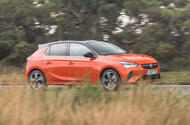
A lot of supermini for the money – and there’s petrol, diesel, hybrid and EV to choose from
In 2021 the Vauxhall Corsa finally became Britain’s best-selling car after more than 30 years of trying, and it remains a consistent fixture of the top five to this day.
It thoroughly deserves its commercial success too, because it’s well-rounded, pleasant to drive, decently equipped and available with a broad mix of powertrains.
Its popularity also means there is an abundance of current, ‘F’- generation Corsas on the second- hand market – many for a bargain price, with the earliest 2020 cars starting from less than £5000.
The Corsa F is closely related under the skin to the Peugeot 208, sharing its CMP platform, powertrains and dimensions. A keener driver will tease out subtle differences in chassis set-up, but the two are so similar that your preference largely rests on which one you prefer the look of.
Let’s assume it’s the Vauxhall. (And why not? It’s a handsome- looking thing.) Most used F Corsas are 1.2-litre Puretech petrols with the tricky disintegrating wet belt (see Buyer Beware, right), or you can up your budget for the later, more reliable chain-driven motor, which also brought the option of mild-hybrid power.
Longer-haul drivers will like the idea of the 1.5-litre diesel, which has enticing cruising economy (70mpg) and decent refinement, but it’s relatively scarce. There’s also an electric model. Now available from just £7500 with a 175-mile real-world range, it’s one of the best used small EVs out there.
Regardless of powertrain, all Corsas share a compact exterior (it’s less than 4.1m long), with an interior to match. While the space up front is generous enough, the back seats are more cramped for average-sized adults and a Polo, Ibiza or Fiesta will be more spacious. But the Corsa’s 300-litre boot is about right for the class. It feels decently premium and well-built inside too.
The 10in infotainment system – or 7in on pre-facelift (before mid-2023) lower-spec versions – is simple to use and it’s supported by physical buttons to operate key functions. On the road, the Corsa is easy to rub along with. The 1.2-litre petrol is smooth and torquey, the diesel impressively vibration-free and the electric version punchy and supremely quiet at low speed.
The sense of big-car refinement and quality is broken over coarse roads, when the ride feels wooden. It’s not great on 17in alloys but is passable on 16s – and the EV has a more settled ride than ICE cars. Most Corsas have an adequate 99bhp from their 1.2-litre turbo petrol. Some early versions had just 74bhp and were naturally aspirated, while a 128bhp tune came with a hesitant auto gearbox. We’d stick with a six-speed manual 99bhp car, which should be good for 50mpg and 0-62mph in a little over 10sec.
In 2024 a couple of hybrids joined the range (with 108bhp or 143bhp) offering 60mpg and a smoother dual-clutch automatic gearbox. With the EV (134bhp or 154bhp), the later you go, the better the range. Early 50kWh cars will do 150 miles in the real world, but later versions boost that to 175 miles, and a heat pump was offered as standard from 2022, keeping that range more realistic in the winter. In 2024 a 51kWh battery was added as an option, boosting the real- world range to 200 miles. There’s plenty of choice, then, and plenty of rational appeal. It’s a sensible kind of car that offers quite a lot for not very much outlay.
What to look out for
Petrol engine: The degrading wet belt is a potential ticking time bomb, but frequent, high-quality oil changes can prevent a costly failure. A chain-driven 1.2-litre petrol (optionally hybridised) is a safer bet and you can spot it by the oil cap being to the left of the middle of the engine cover, rather than the front left.
Diesel engine: The 1.5-litre diesel has a traditional timing chain but it is also prone to premature failure, causing extensive engine damage, even after a 2022 recall that replaced the 7mm chain with an 8mm version.
Clutch: A sticky pedal action could be a problem with the master or slave cylinder, the release bearing or the return spring. Budget up to £1000 for the first two, or around £100 for the last two.
Gearbox: Problems often occur at around 30,000 miles and mainly affect manual transmissions. Grinding or crunching noises indicate wear, which in some cases may require replacement of the entire gearbox, although a software update of the transmission control unit or an oil change can help.
Infotainment: It’s never been the quickest or slickest system, but turning the car off and on again should solve any glitches and crashes.
Interior: Faulty clips can make it difficult to operate the folding rear- seat mechanism. Occasional failures have been reported with the electric windows and occupancy sensors.
Also worth knowing
A Corsa loses value far more quickly than a Polo, Fabia, Fiesta or Mini – which means it’s a buyer’s market. The less you spend, the less you lose when the time comes to move the car on. A facelift in mid-2023 made the Corsa look more distinctive and upmarket with the introduction of the brand’s new ‘Vizor’ face. Before the facelift, trims ascended through SE, SRi, Elite (all with the option of Nav, Premium and Nav Premium) and Ultimate. We’d recommend SE Nav Premium as it’s very well equipped and doesn’t have the ride-inhibiting 17in alloys. Since the facelift, trim levels have been Yes, Design, GS and Ultimate.
How much to spend
£5000-£7499 Well-used, often low-spec ex-company and driving school cars. Check for a fastidious service history and evidence of a belt change (petrol) or chain change (diesel).
£7500-£9999 More desirable specs and lower mileages (around 60,000) plus EVs for roughly a £1000 premium.
£10,000-£13,999 Low-mileage, high-spec three- and four-year-old petrol Corsas and a few diesels.
£14,000-£30,000 Facelifted cars from 2024 onwards, chain-driven petrols and hybrids. Corsas from 2026 start at £16,000.
An owner’s view
April Sparkes: “I’ve just bought a new, unregistered Corsa Electric for £16,000 from a Vauxhall main dealer and couldn’t be happier. People criticise the depreciation of EVs, but at that price it doesn’t look like it will lose money any faster than any alternatives. I was looking at getting an automatic petrol initially, but the problems I had with my old Peugeot 208 and the fact that I never drive very far decided it for me. So far, it’s been smooth sailing and has saved me a chunk of change in petrol too.”