Chinese brands are making rapid inroads into the UK market – how did the Japanese do it fifty years ago?
As Chinese brands have begun swarming into the British car market and a Jaecoo has topped our sales chart, many have drawn comparisons with the rise of the Japanese in the 1970s, led by Datsun (Nissan).
And while there are some major differences between the two tales, there are also some parallels.
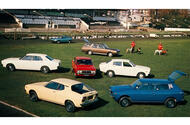
Datsun began exporting “a carefully selected range of cars” to the UK in autumn 1968, having “completed plans for a distribution centre [so that] supplies of new cars, spares and the facility for proper after sales service are assured”. Whereas Jaecoo spent its first year here selling only the 7 SUV, Datsun arrived with seven saloons and estates from the Sunny (badged simply 1000), Bluebird (1300 and 1600) and Cedric (2000) ranges.
Our first Datsun road test verdict read: “At £1065 [£17k now], the 1600 De Luxe Estate comes high up in the price list for this type of car. It does have excellent performance and a very good specification, but it falls down badly on roadholding and ride”.
It didn’t hit the ground sprinting like Jaecoo, but Datsun did grow quickly, registering 6000 cars in 1971, then 30,000 in 1972. With it on track for 50,000 in early 1973, we commented: “While some foreign cars sell because they offer specific gains in comfort or performance over their British competitiors, the majority sell by default on the part of British manufacturers.
“While some still derive comfort from full order books and long waiting lists, they all acknowledge that this very delay can ultimately prove to be their undoing. Extremely serious, however, is the apparent direct relationship between labour troubles in our own industry and the percentage gain in the British market by imported cars. It was always suspected that our import figures would rise to the European levels [of around 25% after we joined the Common Market in January 1973], but no one thought it would happen so suddenly”.
By March 1973, Datsun had a 2.9% UK market share, putting it among the established big three of Renault (3.9%), Volkswagen (2.8%) and Fiat (2.3%), thanks to a 225-strong and still growing dealership network. “Clearly the time has come for consolidation rather than expansion,” the firm acknowledged in an advert in Autocar. “There is a strong need to build up the spares and service network; Datsun do not want to sell more cars than they can look after. [Therefore it is] building a new UK headquarters comprising offices, computer centre, service and sales training school and spares warehouse at a cost of £3.5 million”.
Enjoy full access to the complete Autocar archive at the magazineshop.com
This was to be in Worthing, West Sussex, near the port of Shoreham, where Datsun UK had grown out of the former import operation for German minnow NSU. By 1974, Datsun UK had outgrown the Shoreham-via-Rotterdam import route and had cars coming direct from Yokohama to Middlesbrough. Like BYD in the modern day, it had capitalised on vertical integration, commissioning Japan’s first roll-on, roll-off car ship, which would then return home with British exports.
Another major advantage for Datsun was the supreme reliability of its cars, which it credited to “the emphasis given to inspection”. Its Oppama plant, for instance, had no fewer than 780 quality inspectors – unimaginable to British Leyland. Datsun also unpicked the snags in finance and insurance that usually afflicted foreign cars, establishing its own finance firm and coming to a special arrangement with Lloyds. By 1977, Datsun had full dealer coverage of the nation and was the top foreign brand, with a 6.5% share – and its model range had swelled to 22, gaining coupés, upmarket six-cylinders and even a sports car.
Buyers were generally delighted. “My Cherry is a gem, completely reliable and very economical,” one Keith Miln was quoted as saying. “It has averaged a staggering 46.8mpg”. “Our Bluebird is in use 24 hours a day and is averaging 32mpg,” said taxi firm owner Gordon Henderson. “They’re perfect for tuition: easy to drive, reliable and economical,” added driving tutor Jack Coulson. As for the dealers, John Martin of Belmont Garages in Edinburgh said: “If I was asked to draw up a list of pros and cons on working with Datsun, the list would be all pros”.
In the following years, Datsun continually strained against a 10% import limit imposed on Japanese firms, so in 1984 it decided to build a factory in the UK a move then replicated by Toyota and Honda. Hopefully that will be another parallel that we can draw with Chinese brands in the future.