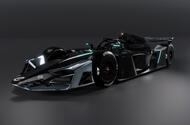
Formula E is stepping off the sidelines with its fearsome new 210mph racer – and more emphasis on proper racing
You can take it or leave it – and, let’s face it, so many true-blood motor racing fans prefer the latter option.
But even the haters can’t deny it: Formula E has lasted far longer than most expected. Now in its 12th season, the electric single-seater series has survived early technical glitches, widespread scorn, manufacturer pull-outs and a global pandemic to somehow keep the spark alive.
Soon comes the next chapter, and a fourth- generation Formula E racer on which rest a couple of gigawatts of both promise and faith. But forget unlucky for some: unleashing Gen4 in season 13 at the end of this year could and, judging by our first contact, should raise the Formula E game – and in a way that all racing fans and car lovers should genuinely care about. So put aside your EV prejudice, overlook the grating whine… Don’t think about the electric bit. Just consider this as a new racing car – one that is properly, stupendously and seriously fast.
The Gen4
It’s a long way from the first generation of 2014, when limited range forced drivers to switch cars mid-race just to get to the finish. You can see the progression in our performance chart overleaf but, in short, the Gen4 takes a significant leap even from the already rapid current Gen3 Evo.
Topping out at 210mph, the Gen4 does 0-62mph in 1.8sec and 0-124mph in 4.4sec – 1.5sec faster than its predecessor. In race mode, it has 50% more power and is projected to lap as much as 10sec faster over some laps in qualifying mode. In Attack Mode, which drivers are obliged to trigger for a set period of time in each race, a whopping 600kW (805bhp) is available through all four wheels. And Formula E becomes the only single-seater series to offer permanent all-wheel drive.
So the unavoidable question: how does it compare to Formula 1? The only place where both series race at the same track configuration is Monaco – and “last year in qualifying, F1 was 18% quicker in lap time”, says Porsche’s factory motorsport director, Florian Modlinger. “We were around Formula 3 pace with Gen3; with Gen4 the target is to be in between F1 and Formula 2.”
GEN 1
GEN 2
GEN 3 EVO
GEN 4
Wheelbase
3100mm
3100mm
2970.5mm
3080mm
Min weight*
900kg
903kg
863kg
950kg
Max power
270bhp
335bhp
470bhp
805bhp
Max regeneration
150kW
250kW
600kW
700kW
Energy recovery
About 15%
About 25%
Nearly 50%
Over 40%
Powertrain
RWD
RWD
RWD/4WD
4WD
Top speed
140mph
174mph
200mph
210mph
*including driver
Spectacle now key
When Formula E was inaugurated in 2014, the environmental angle was a clear and obviously worthy messaging point. Sustainability remains at the heart of the series, but we hear that all the time from everything and everyone, whatever they’re selling. What has changed in Formula E now is the emphasis on the sporting spectacle.
As Jaguar team principal Ian James puts it: “We’ve got to stop referring to ourselves as the pinnacle of electric racing. We should be able to stand on our own two feet as a world-class sport.”
Earlier this year, Max Verstappen shone a light on the series when he suggested the new- look F1 was too much like Formula E. Contrary to popular perception, he wasn’t being derogatory: he later clarified that he likes the electric series but believes F1 is wrong to go down the same path of energy management motor racing. He has also apparently given a thumbs up to Gen4, branding the new car “cool”.
Formula E CEO Jeff Dodds spends more of his time than he would wish talking about the F1 comparison. “Any time you’ve got a generational talent, a four-time world champion, talking about your sport, that’s not a terrible thing,” he tells me at France’s Circuit Paul Ricard, where I’m witnessing the ‘unleashing’ of Gen4. “Also, while a lot of people wanted to interpret his comments in many different ways, [Max] clarified them: ‘If we want to race electric cars, race electric cars. Why are we trying to sit on the fence between these two technologies? We are losing some of the special sauce we have in F1.’ I have some sympathy with that conversation.”
What’s intriguing is that Formula E and F1 now share the same rights holder. American media giant Liberty Global controls both. Dodds’ boss, Liberty Global CEO Mike Fries, was also at Paul Ricard. He referred directly to F1 as “our cousins” and added a good-natured dig – something about “no half measures” and how Formula E was “all in”.
Like all motorsport leaders outside F1, Dodds knows his series can’t compete with grand prix racing when it comes to a global audience. “We’ve said by 2030 we want to be the second-biggest [form of] motorsport, only behind F1, and I think that’s doable,” he says. “It will be interesting to see how F1 develops in a post- combustion era. We’re the only people who can race all-electric [single-seaters].” That references a cast-iron contracted guarantee given to Formula E by motorsport’s global governing body, the FIA.
Energy management racing
If wow-factor spectacle is central to Formula E’s premise, why must its drivers and race engineers focus so heavily on managing energy corner to corner, lap to lap in races? That won’t change with the Gen4. Given Formula E’s obvious and genuinely gargantuan progression in technology, why does the racing equivalent of range anxiety remain a pillar of its show? It seems odd that a series that showcases EV capability plays up what is still the major turn-off for buyers of new road cars.
“We work on the basis we want to race for about 50 minutes,” explains Dodds. “With the incredible power this [new] car has, even with its regeneration capability, if we just said ‘go wild, foot to the floor, no energy management, you wouldn’t get what we think is an optimal race time for a fan.”
Dodds also insists this element is good for the show: “If you have energy management, it does a couple of things. One, it’s highly strategic. Two, it creates close pack racing. If we went to a sprint race version and unleashed this car, it would be a pretty incredible spectacle, but it would be a much shorter race.
“There could be room for multiple different formats going forward. But as the technology gets better and battery development is on such a curve, you might get to a point where you could race for an hour with zero energy management. That would be a great problem to have.”
Car makers still love it
Mercedes-Benz, BMW and Audi, most recently McLaren and Maserati: all dipped in and now have dipped out of Formula E. But there’s still an impressive roster of six that have bought into Gen4: Porsche, Jaguar, Nissan, Mahindra, Lola-Yamaha, and Stellantis (with a start-up Opel entry replacing DS alongside Citroën). The likes of the Indycar Series and World Rally Championship would love such a mass commitment.
This year marks Jaguar’s 10th anniversary in Formula E. Principal James, who switched from departed McLaren for this season, has spent eight years in the series and half his career in the mainstream automotive industry.
“There’s the technology itself that we’ve been developing,” he said when asked why the JLR brand remains wedded to this form of racing. The race-to-road transfer is genuine, he insists. “In motorsport we don’t have the constraints that are necessary in mainstream automotive. We can push the boundaries harder, fail faster and learn. There are already key elements on the Formula E powertrain that have fed back into Jaguar road cars.”
What the drivers think
At Paul Ricard, other than Formula E’s own test and development car, only Porsche, Jaguar and Opel have a Gen4 to run on track. Not all of the drivers have driven one yet, which is why so many are watching eagerly, with a palpable sense of anticipation (and envy).
Porsche’s duo are among the lucky few to have already racked up Gen4 miles. “First impression is it’s a lot faster,” 2023/24 champion Pascal Wehrlein says. “A lot more power, downforce, grip when braking; we’re now pulling almost 4g at times. I’d also say it’s even more complex than the Gen3. It’s very impressive, the acceleration out of the corners. I’m looking forward to the feedback from fans.” Nico Müller adds: “As drivers, we always look for speed and this is a huge leap – a revolution on track.”
Dimensionally, the Gen4 is visually bigger – as emphasised when all four generations of car lined up on the pit straight. Oversized and heavy is a common trend in modern motorsport but, crucially, Müller points out these four-wheel- drive beasts are more agile than you might expect. “You can wrestle this car, it rewards being a bit more aggressive,” he says. “That makes it enjoyable from inside and outside. Although the car is much bigger, we can still go wheel to wheel. The racing will still be tactical, still a unique mix to manage energy and slipstream to find efficiency. Also, it’s an engineering challenge which Pascal and I enjoy.”
Energy management racing can be complicated to follow, but racing drivers do genuinely seem to relish this aspect. Going flat out is for qualifying, they say, but racing is and should be more nuanced.
More space to race
From the beginning, Formula E has traded on taking its ‘green’ form of racing into the heart of the world’s major cities, where there’s no place for noisy, fossil-fuelled V8s. But characteristically, most of its street tracks are confined, short and tight. Everyone involved accepts some will no longer be suitable, given the Gen4’s extra power and size.
These cars no longer look slow on normal race tracks but, as Wehrlein points out, city races are “part of Formula E’s DNA”, so an ideal calendar would include a mix of venues. The recent Gen3 Evo round at old-school Jarama in Spain (with a chicane added on the pit straight) went down well. Options for where Formula E can and should race have now opened up – but London’s indoor-outdoor Excel track definitely won’t work. The hot money is on a British round at Silverstone. Dodds admits the home of the British GP is “in the mix” but adds: “We don’t just want to race on the same circuits as F1.”
Will you watch – or care?
Dodds admits that winning over traditionalists remains tough. “Sometimes it feels like people take a moral position [on EVs], and we’re certainly not asking them to do that,” he says. But for what it’s worth, here’s what James said when we asked how he would convince Autocar readers to give Formula E a chance: “I was at the Monteblanco circuit in Spain a couple of months ago for our first-ever Gen4 test, and I remember the driver taking off their helmet after the first couple of laps and seeing the grin on their face. It tells you all you need to know if you are into cars and like your motorsport. Gen4 is going to be full-on entertaining – probably the world’s best motor racing.”
From the cockpit
James Rossiter knows all about powerful racing cars. A former F1 test driver, he has raced the biggest, most brutal of the modern breed – Super Formula and Super GT in Japan, LMP1 prototypes and Hypercars around the world. It would take a lot to impress him, then, but as Gen4’s test pilot, his adrenaline-fuelled reaction at the Paul Ricard launch appeared genuine. Here’s what he told us.
“Having four-wheel drive, the acceleration from the apex is faster than an F1 car. It’s unbelievable. You have instant power, so much controllability in your right foot. Everything is right there. It’s such a unique experience to have that power – it’s going to open every single driver’s eyes.
“And they are very agile, that’s what surprised me during the development phase. [French car constructor] Spark has done such a great job in the suspension geometry, to pad out what we have learned with the Gen3 car with the powertrain on the front, utilising the front axle while having such an agile car. It’s really done well.
“I’m super-excited to see a younger generation joining Formula E, because this car really is only second to F1. To many drivers, I think it will be more appealing than F1 too.”
Trackside view
Every time I head to a race track, I’m looking for that old buzz. The hair standing up on the back of my neck, just as it did when I was a kid experiencing the shock and awe of F1 for the first time way back in the 1980s. A few days before Paul Ricard, I’d felt that thrill again as Jenson Button demonstrated his 2009 Brawn at Goodwood, so Gen4 had a lot to live up to.
But standing on the pitwall, face pressed to the wire-mesh fence, there it was again as James Rossiter rocketed away from a standing start. Okay, the whine has nothing on a V8 and V10 shriek. But the eerie whoosh and scrub of tyre rubber as Rossiter fired past on a flier… First time through, your brain struggles to comprehend the speed. The close-encounter experience is up there with watching an Indycar power through an oval turn without lifting or the day I saw a first-generation, plain-carbon Audi R18 turbo diesel LMP1 ghosting along Sebring’s main drag. That’s a good sign.