It is one of the UK’s fastest growing motorsports for amateurs – where low-cost of entry is the big attraction
Members of the public weren’t admitted, but had they ventured onto RMB Chivenor, a Royal Marines base on the Devon coast, one Sunday last April, they would have witnessed around 50 well-worn cars spanning a 1972 Ford Escort to a 2007 BMW 123d being driven hard around its runways, access roads and grassy outfields.
All day, the motors – among them rarities such as a 1987 Volkswagen Golf GTI and a 1990 Toyota Corolla GTI, plus oddballs including a 1997 Proton Satria and a 2003 Ford Fusion – tore one after the other around the camp, occasionally braking violently to a stop beside clusters of officials, who were timing them to the second. It was a rally, but not as we know it…
Welcome to Targa road rally, the fast-growing motorsport for amateurs where low-cost of entry is the big attraction. My first taste of the sport was a YouTube film of the 2023 Classic Tracks Targa Rally. It showed ordinary cars in road trim tearing around an old farm while groups of spectators yelled encouragement. Narrow your eyes and it could have been a 1970s round of the Lombard RAC, but with one key difference: none of the drivers and navigators was wearing a helmet.
The argument goes that things like helmets, fireproof overalls, fire extinguishers and roll-cages add cost and discourage participation in grassroots rallying. That said, it’s worth noting there are two types of Targa rally: Silver Star and Gold Star, both run under the auspices of the BTRDA (British Trial and Rally Drivers Association), which supports club-level competition regulated by Motorsport UK. In its lower cost of entry, Silver Star is closest to the spirit of a Targa rally.
To enter a Targa rally, you must be a member of a car club and hold an RS Clubman licence, which is free from Motorsport UK. An Inter Club licence is also acceptable. In addition, the club hosting the event will impose an entry charge. At North Devon Motor Club’s Targa rally, held at Chivenor in memory of Stu Wood, a much-missed member, teams paid a modest £180 – a fee that covered the hire of the venue, which was expertly marshalled.
Cars must be road-legal and only those with engines of no more than four cylinders and with a single cam, or a twin cam if it was standard, and two carburettor chokes or the standard fuel injection system are permitted to compete. Unless it’s a diesel, turbocharged engines larger than 1500cc aren’t allowed.
Noisy exhausts and gearbox shifts that aren’t the traditional H-pattern are also not permitted. A roll-cage is allowed but not mandatory. To keep things simple, the car’s headlining, carpets, rear seats (where fitted) and original door cards must be retained. Seatbelts can be of the conventional lap belt variety. There are no rules regarding the type of clothing crews must wear.
This light regulatory touch has a direct bearing on the cost of competing. While many cars at Chivenor were dressed to impress, with knobbly tyres, race seats, bonnet catches and roll-cages, they were in essence completely standard. An almost equal number looked exactly as they did when they left the factory.
That all can compete on equal terms is down to one thing: the average permitted speed is just 30mph.
For proof of what a leveller that is, look no further than Will Jefferis, who finished second driving an ordinary- looking 2002 Nissan Micra 1.4. “I like appearing to be the underdog,” he said. “Driving in a Targa is about technique and not how fast you can go.”
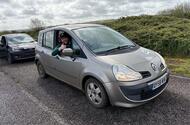
Not that the pace was ever less than full-on. There were 10 tests on the day, totalling 30 miles. Half were on Tarmac and the remainder on a mixture of Tarmac, grass and gravel. Regardless of the surface, the drivers drove like their lives depended on it. Father and son Sean and Connor Merrifield had turned up in a 2008 Renault Modus with a sat-nav unit crudely taped to the dashboard and piles of clutter still on the back seat. They finished 17th in the Clubman class, which is for holders of the RS Clubman licence. Other entrants included a couple contesting a 2003 Ford Fusion (they finished last).
Josh Martin and co-driver Dave Motterham were manning a 2000 Mazda MX-5. “Targa is similar to stage rallying in the 1970s,” said Motterham. “It’s cheap and accessible but it’s taught us a lot about setting up a car.” They finished eighth in the Inter Club class for holders of the Inter Club licence, which is £85 but opens the door to more championships.
By close of play, the overall winners across both classes were Jamie Raymond and Oliver Luxton in a 2000 Ford Puma. Zak Linham and Harry Blackmore won the Clubman class in a 2003 MG ZR. However, judging by the smiles of all the participants, everyone was a winner.
A quick guide to Targa
Targa road rallies emerged from gymkhanas, road rallies and endurance rallies, and over the past decade the sport has taken off as other championships have withered.
Its attraction is the low cost of entry and the fact that you can start in an everyday road car with almost no preparation required – although if it’s a particularly challenging event, you might want to consider tyre selection and underbody protection.
Another draw is that at some Targas, two entrants can take turns at the wheel – and some entrants have been known to buy a car only a week before an event.
Surfaces can range from clean asphalt at race circuits to forest stages. There are more than 60 Targa rallies, and keen participants can progress in the sport through the BTRDA Silver Star Championship.
Images by Paul Morris