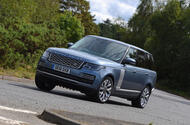
An ‘L405’ Range Rover can do it all, but there are some vital ground rules…
How good is the ‘L405‘ generation of the Range Rover?
Put it this way: last year, we were confident enough to declare a used £55,000 L405 a better buy than a new Kia Sorento for the same price. Which is especially attention-grabbing when you consider an L405 Rangie can now be picked up for just £10,000 (even though we would advise spending a little more, if you can).
And just look at it. It’s upright, stately, monolithic, inherently classy unmistakably and unapologetically a Range Rover, in other words. While it’s not quite as regally brutalistic as its ‘L322’ predecessor, it’s a mighty fine piece of design and brought the lineage into the modern world with a 0.30 drag coefficient (down from 0.38), a kerb weight starting at 2160kg (down from 2438kg) and up to 40mpg as a result.
It impressed our road testers when it was new as well. They found this generation of Range Rover a joy to be with. It looks the part as you walk up to it, yet it’s not as overtly flashy as an equivalent BMW or Mercedes. Inside, that theme continues: it’s beautifully rich in feel and smell, with real leather and wood (metal/carbonfibre was also available) giving a warming and comfortable vibe.
Yes, the infotainment of early cars leaves a lot to be desired (the 2018 facelift improved usability and connectivity a lot) but the driving position is spot on commanding like nothing else and with knobs and buttons within easy reach.
On the road, it delivers comfort and isolation that can only be beaten (in this lofty price bracket) by a Mercedes S-Class. What the Benz can’t do, though, is tow 3500kg and wade 900mm. It’s easy to forget how competent a Range Rover is over really challenging terrain when it’s also so adept at trundling around town or shrinking the miles during a motorway slog.
The Range Rover works well in more everyday scenarios as a family chariot too. Its 900-litre boot (2000 litres with the seats folded) is cavernous, while the large glass area (with optional giant sunroof) helps to brighten the mood on a long haul. And it makes this five-by-two-metre beast relatively easy to place on the road and park.
There’s tri-zone climate control (quad-zone was optional) to keep your VIP passengers comfortable, and even heating, cooling and massaging seats for four occupants on some models. Leg room is adequate and amazing with the 200mm-longer LWB model.
As for the engines, they’re all good, if temperamental. The base 3.0-litre V6 diesel delivers plenty of poke and reasonable economy (mid-30s to the gallon is realistic) while the 516lb ft, 4.4-litre V8 diesel is indulgent but not too punishing (30mpg is achievable). Most cars have one of these two options. However, there’s also a thirsty 5.0-litre petrol V8 with 503bhp, 517bhp, 542bhp or 557bhp.
The plug-in hybrid that arrived with the 2018 facelift has a 2.0-litre petrol and thus feels a little inadequate, while the 40mpg-capable hybrid V6 diesel is rare but worth seeking out. Whichever version you choose, the elephant in the room is the cost of running it.
But it needn’t be as bad as you might think. Buy the wrong one and it could be a money pit, sure. But buy with care and it could be the best all-rounder you’ll ever own. The risk-reward factor is strong with this one.
What to look for
Engines: On the TDV6 and TDV8 diesels, the crankshaft is known to fail. Some last 20k miles, but some 200k, and owners recommend regular servicing and letting the car warm up before driving to help boost longevity.
Electrics: There are a lot, they’re all complicated and they’re known to intermittently glitch out. From boot switch to brake light, nothing is immune from failure although it’s not a foregone conclusion. Gremlins can vary between a £20 switch and a far more expensive rewiring. Post-2016 cars are best.
Gearbox: All versions use the eight-speed ZF unit. Owners recommend servicing every 50,000 miles to keep it in good health.
Body: The Range Rover lettering on the bonnet is known to tarnish and Land Rover will charge £250 to fit new badges. Or you can do it yourself for £10. Check absolutely everywhere for evidence of off-road knocks and parking dings both likely.
Chassis: This is a heavy machine and that can take its toll on the suspension. Track control arms are a common fail point; budget £700, including labour, to replace.
Also worth knowing
Trims run in ascending order from Vogue to Vogue SE, Autobiography and SV Autobiography. Westminster and Fifty were special editions that arrived towards the end. All are well-equipped and lots of Vogues had thousands of pounds of extra kit added to them to bring them close to Autobiography cars. It’s rare to find 19in wheels but they’re the most comfortable; 20s and 21s are a good compromise but 22s are a little fidgety on the road for our liking.
There were three main updates for this generation: 2016 brought better infotainment tech, ULEZ compliance and improvements in reliability; 2018 was the big facelift and included the arrival of LED lights and three screens; 2021 introduced new 3.0-litre mild-hybrid straight sixes that are smoother and more economical than their predecessors (296bhp or 345bhp for the diesel and 395bhp for the petrol).
How much to spend
£10,000-£17,999 Buy very carefully in this price bracket. Some cars have megamiles (more than 200,000 not necessarily a bad thing) while some will be lemons with temptingly low mileage.
£18,000-£29,999 Lots of high-spec, pre-facelift cars with reasonable miles and a good service history.
£30,000-£39,999 The sweet spot: low-mileage, pre-facelift cars with long warranties available here.
£40,000 and above Last-of-the-line, high-spec models. Specification has a bigger impact on value than the engine, which seems to make little difference.
An owner’s view
Alie Smith: “I’ve got an Autobiography on a 63-plate, now with 96,000 miles on the clock. I bought it five years ago when it had done 70,000 miles. I service it on the button at an LR specialist and seem to spend an additional £600 per year on the odd replacement part, on top of servicing costs. The car is utterly majestic. In my experience, there’s nothing quite like it. The Meridian 1700W stereo is exquisite almost certainly the best car stereo you’ll ever hear. My car’s build quality is excellent. There’s not a squeak or a rattle anywhere. Go and buy one.”