Rule-breaking silhouette was developed with the man who designed the iPhone
Prancing Horse plugs in: mad Luce brings radical styling and performance specs to match its V8 and V12 siblings
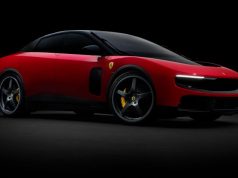
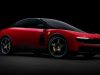
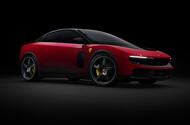
Ferrari has revealed the exterior design and full technical details of its new Luce electric car. Ferrari’s second five-door car (after the Purosangue) and its first five-seater will go on sale priced at around £440,000, with UK deliveries set for spring 2027.
The Luce has four electric motors, one for each wheel, making a combined 1036bhp, with a 122kWh battery giving it an estimated range of 523 miles (subject to homologation).
In terms of performance, Ferrari says the Luce will be able to reach 62mph from rest in 2.5sec, travel from 0-124kph in 6.8sec – making it one of the firm’s fastest-accelerating models yet – and go on to a 192mph top speed.
It’s also the firm’s largest car yet: at 5026mm the Luce is 53mm longer than a Purosangue, while measuring 1999mm wide across the body, and 1544mm high, 45mm lower than its V12 sibling – with a 2961mm wheelbase.
Design
The Luce’s design is primarily the work of LoveFrom, the design agency founded by industrial designers Sir Jony Ive – best known for designing the iMac, iPhone and iPad during his time at Apple – and Mark Newson. Ferrari has used design houses such as Pininfarina, Bertone and Zagato before, but it says that its relationship with LoveFrom has helped it think radically.
Members of the LoveFrom team, which has studios in San Francisco and London, have also been based in Ferrari’s offices at Maranello. “We’ve been working hand in glove with Ferrari for the last six or seven years,” Newson said at the Luce’s launch in Rome. “It’s safe to say that we’ve been completely embedded within the Ferrari organisation.“
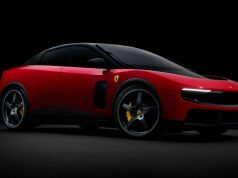
The Luce is a five-door hatch, with aft-hinged rear doors and a cab-forward design – the distance from driver’s seat to front axle is the same as in the 296 GTB – which lends the car a spacious interior.
Rather than the focus of its styling being on downforce as would usually be the case with Ferraris, more attention here has been paid to aerodynamics. The design theme is for it to resemble a two-piece body; the black glassy volume contained within a coloured outer shell, is not dissimilar to the way the 12Cilindri’s glass and gloss black volumes look inserted inside its body panels. “You might call it a glasshouse, or we like to call it a passenger cell,” said Newson. “Those things are intrinsically connected, but we like the idea of them as separate design elements.”
The Luce has ‘floating’ front and rear spoilers, each separated from the black form, allowing air to flow between the body and “this smooth, inherently aerodynamic object [inside],” said Newson. While Ferrari doesn’t quote a number because the car has to still generate some downforce to cope with its prodigious top speed, it says the Luce has the lowest drag coefficient of any roadgoing Ferrari: 25% less than an Amalfi, while having the same kind of downforce.
The car has been through two and a half times the number of CFD calculations as the Purosangue during its development, reflecting the importance of aerodynamic efficiency in an EV. “Drag means range [loss],” said aerodynamicist Matteo Biancalana. The front door strake vents air from the front wheelarches, while the rear wheelarches vent at the rear, and there are active cooling fins at the front to reduce drag. The windscreen wipers are mounted vertically at the windscreen edges to keep a smooth profile to the passenger cell.
The body-in-white is an entirely new aluminium structure, composed of extrusions, castings and sheets, into the floor of which is mounted a battery pack, which is also assembled in Maranello. Ferrari claims torsional rigidity is’’ up 35% over the Purosangue, while the Luce also has Ferrari’s first elastically-mounted rear subframe, to improve NVH, from which the lower suspension arms and rear motor module is mounted.
Interior
Elements of the Luce’s interior design had been shown in part before the car’s unveiling this week, but this is the first time Ferrari has shown the elements together inside the finished cabin.
The short-bonnet design and absence of a transmission tunnel free up enough space for the Luce to host Ferrari’s first five-seat interior, as well as 40/20/40 split rear seats with a 597 litre boot behind – Ferrari’s largest yet.
But the most notable elements of the Luce’s interior are surely the control surfaces that were previewed earlier this year, and which feature high-grade materials and physical buttons and dials. “Just because the vehicle is electric doesn’t mean we need to get carried away with electronics,” said designer Marc Newson, another Apple alumni. The idea was to have “the minimum distraction possible.”
There is a small, thin-rimmed steering wheel reminiscent of classic Ferraris, as well as glass-fronted and -backed dials which feature both physical needles and high-definition digital displays. Most controls can be felt for rather than having to be looked at, and all are engineered to feel heavy, or positive, to the touch. “Jony [Ive] and I are car enthusiasts, right?” said Newson. “We’re petrolheads, I guess, for want of a better expression. We’ve owned Ferraris – old Ferraris, historic Ferraris. I’m an obsessive classic car collector.
“I’ve done the Mille Miglia 14 times. And I appreciate – we appreciate – the straightforward ability to be able to interact with things in a coherent, spontaneous way. And it occurred to us very, very early on in this process that, in fact, that was what Ferrari really fundamentally is about.”
Tactile and perceived material quality is high on the agenda, too. “There’s a sort of the litmus test that we applied to all of these objects,” Newson said, “that every single one of them was beautiful; not only a beautiful object, but a beautifully-crafted object, a beautifully-made object.“
Apple CarPlay and Android Auto are supported, and personalised ADAS preferences are available with one button-push on the steering wheel.
Powertrain
The Luce’s four electric motors produce a system total of 1036bhp and a maximum torque output of 739lb ft, which is heavily rear-biased, with 416bhp and 262lb ft produced by each rear motor, and 141bhp and 103lb ft coming from each front motor.
The radial flow, permanent magnet synchronous motors are a derivative of the type used in the hybrid drivetrains of Ferrari’s GT racers and the F80 hypercar. The front motors can spin at up to 30,000rpm, while the larger rear motors top out at 25,000rpm, owing to their larger outer diameter, different gearing and a larger wheel diameter at the rear. The motor and gearbox module at the front weighs just 65kg, with the rear at around 130kg.
With a motor for each individual wheel, the Luce can torque vector to improve agility or stability. And the front motors will disengage in Range mode, but otherwise always remain engaged in Tour and Performance drive modes.
The battery, weighing 630kg, is designed and built in Maranello and integrated into the car’s floorpan. Designed with Korea’s SK On it consists of 210 cells connected in series, arranged 14 per module, with 15 modules in the pack – one centrally at the front behind the front axle, then mounted two by two to the rear, where the last four are stacked two-high, beneath the rear seats.
They have a peak discharge rate of 830kW and a total capacity of 122kWh at 800V, with a usable capacity of around 11kWh. The Luce’s peak charge speed is claimed to be 350kW, though Ferrari says it’ll take 70kWh in 20 mins: a sustained rate over that time of 210kW.
The battery pack is designed and built in Maranello so that Ferrari – which says 90% of all of its cars are still on the road – can place new battery tech into its own pack design should it need to, even decades down the road – in a similar way to how it’s offering F80-derived packs for LaFerrari batteries now.
Dynamics
While the Luce weighs 2260kg, it has a centre of gravity that’s 95mm lower than a Purosangue’s and a yaw moment of inertia that’s 15% smaller. Weight distribution is 47:53% front:rear. It has the largest wheels yet fitted to a Ferrari, with 23in x 9.5J front and 24in x 11J rear wheels, in two different styles – lighter five-spoke alloys or a more aerodynamically efficient turbine design, which gives maximum range. Between them, suppliers Pirelli, Michelin and Bridgestone offer two normal tyres, two winter tyres and a run-flat option.
Ferrari’s Chief Product Development Officer Gianmaria Fulgenzi said the Luce will be “the most comfortable Ferrari ever produced”. Suspension is by double wishbones at the front and rear, and employs an evolution of the 48V Multimatic TrueActive spool valve dampers first used on the Purosangue, which negate the need for conventional anti-roll bars. Here, though, their internal ball screw pitch is increased by 20%, which better absorbs vertical impacts, and they’re 0.5kg lighter at each corner.
Ferrari’s engineers say that the Luce will be extraordinary to drive. Testing chief Raffaele de Simone said that “it behaves like… You have no idea. It’s a new sensation.”
With active rear steer, torque vectoring and the low centre of gravity, the steering response is said to be 15% faster than in a Purosangue even though the rack is the same.
If you ask for a steering response at speed, “you don’t know if the main actors are the steering or the engines,” said de Simone, while insisting that “it’s very natural. It’s always linked to what you ask for.” The chassis and power, he said, “are fused together.”
Ferrari admits that much of its cars’ driver appeal is linked to their powertrains. To enhance the interaction of the Luce, in Performance mode there are amplified sounds – taken directly from the motors and gearsets as they mesh, and amplified into the cabin. “The sound is authentic; the sound is real,” said de Simone. “You can see where it comes from. We didn’t want a fake, nostalgic sound.”
Ferrari’s famous steering column paddles remain, too, but instead of artificial gearshifts, such as in the Hyundai Ioniq 5 N, the left paddle increases regenerative braking, while also reducing the amount of available power.
There are five stages, with the most severe pulling 0.33g under throttle-off deceleration, “more or less the same as the engine braking in a 12Cilindri in 2nd gear,” de Simone said. The right hand paddle reduces that, and increases the amount of available power on full throttle. You can pull any ‘gear’ at any speed, but extra power – around 0.2g of additional acceleration – is released with each upshift, with the top setting liberating the full whack. “It’s not a fake gearbox. The power is cut in slices, not speed,” de Simone said. “We keep the interaction, to keep decision making active.”
The idea is that, in lower-speed corners, you’d want the additional retardation and can’t use all 1036bhp anyway. “It’s not easy to manage full power” on low speed corner exit, de Simone said.
Away from this manual mode, the automatic operation of the Luce has an “almost coasting” regenerative braking level, of around 0.05g, which is “the same as the Purosangue in 8th gear,” said de Simone.
Buying
UK prices for the Luce haven’t yet been confirmed, but it’s set to cost €550,000 in continental Europe, where it’ll go on sale early next year, with an estimate of £440,000 in the UK, plus or minus 10%, where it’ll arrive next spring.