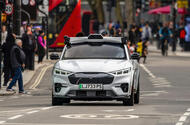
Autonomous driving promises billions for investors, but is that going to be the reality?
Amid the rubble of future business cases that were going to unlock billions in investor value for the car industry, robotaxis and autonomous driving are among the few still standing.
True, autonomous vehicle (AV) flag-waving will look incongruous this year as car companies promote a more ‘back to basics’ message to investors after reality intruded on the dreams of software-led disruption.
But the idea that the self-driving car will tap great wells of untouched revenue still holds sway.
For instance, this year there will be fleets of robotaxis from Waymo, the UK’s Wayve and China’s Baidu on London streets.
The more freewheeling, ‘end-to-end’ Al solution promoted by the likes of Wayve, Tesla and Xpeng offers a faster path to wider city coverage. However, there’s every chance that once the AV prospectors finish drilling, the profits for car companies or anyone else will turn out to be little more than a dribble.
For one thing, the costs will be huge. A robotaxi fleet will have to be operated by the likes of Uber or Lyft, so that’s a significant chunk gone. Then the software provider such as Wayve or Baidu will need paying, given the massive cost of going it alone. For most car companies, robotaxis will be little more than a useful bit of publicity, like Jaguar received from supplying Waymo with I-Paces.
Those, like Volkswagen and Tesla, who want to be an active participant face the same problem as car share companies. Robotaxis in Europe will be intensely regulated by not just countries but also individual cities wary of all manner of issues, ranging from empty cars adding to the jams, to jobs destruction, to wrangles over safety oversight.
America, with its mostly woeful public transport, is fertile ground for robotaxis. But Europe, with a myriad of bus, train, underground and electric bike alternatives, is limited in terms of growth.
As a premium alternative for those willing to pay extra not to gamble on the quality of conversation, driving ability and personal hygiene of their driver, robotaxis will find their niche.
But niches don’t deliver billions of profit. Personal cars are slowly heading in the same direction, but the halfway stage of eyes-on, hands-off driving arguably isn’t appealing enough yet to trigger a mass ticking of the level two-plus option box.
The tech is improving massively but the business case remains jammed.