
Tesla has just given the UK EV market a significant shake-up
As of January 9, 2026, the Tesla Model 3 lineup has been refreshed, and the headline news is the arrival of a new entry-level trim: the Model 3 Standard.
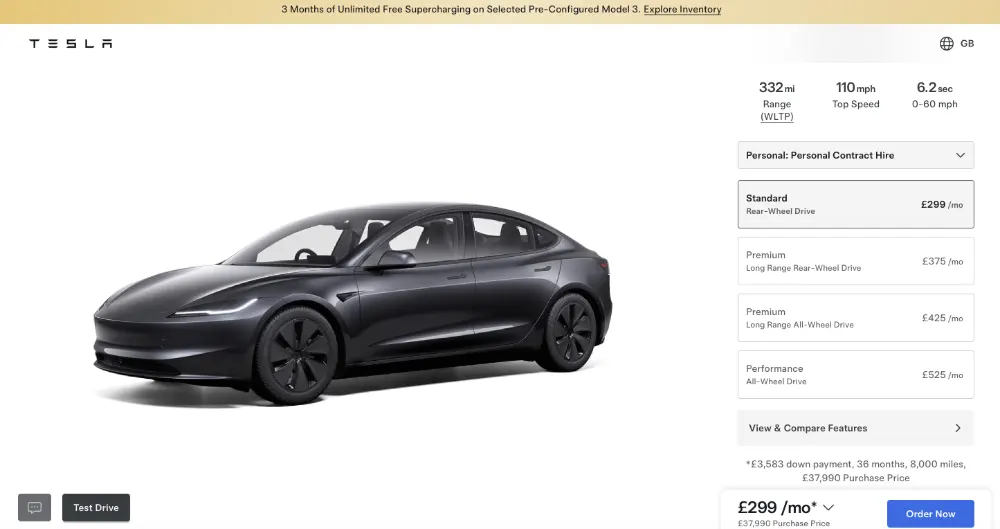
Priced at just £37,990, this new variant officially replaces the previous “Rear-Wheel Drive” (RWD) model as the most affordable way to put a new Tesla on your driveway. But this isn’t just a simple price cut—it’s a tactical move that changes the car’s specifications to tackle one of the biggest hurdles for UK owners: insurance costs.
Tesla are also offering PCP price of just £299 / month. That’s a pretty compelling price for a model 3. Available in Grey as standard with optionals for White of Black for an extra £1,300.The car runs on 18″ Photon Wheels.
The Numbers: Price and Performance
The previous entry-level Model 3 RWD sat around the £40,000 mark. By introducing the “Standard,” Tesla has undercut that figure by £2,000.
Spec
New Model 3 Standard
Outgoing Model 3 RWD
Starting Price
£37,990
~£39,990
Range (WLTP)
332 miles
323 miles
0-60 mph
6.2 seconds
5.8 seconds
Top Speed
110 mph
125 mph
Insurance Group
32
34+
While the 0-60 mph time has slowed slightly and the top speed has been capped, the range has actually seen a small boost. Most importantly for UK buyers, these performance tweaks have dropped the car into Insurance Group 32—the lowest rating ever for a Tesla, making it far more accessible for younger drivers and those in high-premium areas.
The Big Change: Indicator Stalks are Back!
In a move that will delight almost every UK driver, Tesla has listened to feedback. The new Model 3 Standard (along with the rest of the 2026 range) sees the return of the physical indicator stalk.
The controversial steering wheel buttons introduced with the “Highland” refresh have been relegated to the past, making roundabouts and wet-weather driving significantly more intuitive for British roads.
LFP vs. NMC: Understanding the Battery Shift
One of the reasons Tesla can offer this lower price point involves a shift in battery strategy.
The Outgoing RWD: Utilised an LFP (Lithium Iron Phosphate) battery. These are known for being heavy but durable, and Tesla recommended charging them to 100% daily.The New Standard: To save weight and cost, the Standard uses a smaller, more energy-dense battery pack.
The Trade-off: While the WLTP range has technically increased to 332 miles, this is likely an NMC (Nickel Manganese Cobalt) or high-efficiency chemistry variant. For daily use, owners are typically advised to charge these batteries to 80% to preserve long-term health, reserving 100% for long road trips. This means your “daily usable” range might feel slightly different than the old LFP-equipped model, even if the headline figure is higher.
What’s Different Inside?
To hit that sub-£38k price point, Tesla has streamlined the interior. The Model 3 Standard is a “leaner” version of the car we know:
Fabric & Vegan Leather: The seats now feature durable textile inserts rather than full vegan leather.Manual Adjustments: The steering wheel is now manually adjustable rather than powered.Tech Deletions: The rear-seat passenger touchscreen and interior ambient lighting have been removed to simplify production.Suspension: The “Frequency Selective Damping” found on higher trims is replaced by a standard passive setup.
Despite these changes, you still get the panoramic glass roof, the 15.4-inch centre touchscreen, and the full suite of Autopilot safety hardware.
The Verdict: Who is it for?
The Model 3 Standard is a calculated strike at the competition. By dropping the price and the insurance group, Tesla is moving back into the heart of the “mass market” EV space, competing directly with the likes of the MG4, BYD Seal, and the new MINI Cooper Electric.
For Company Car Drivers, the lower P11D value means even more attractive Benefit-in-Kind (BiK) rates. For Private Buyers, it makes the best-selling electric saloon in the world more affordable than it has been in years.
Would you trade a bit of 0-60 speed for a £2,000 saving and cheaper insurance?