Has electrifying the C8 Corvette created a genuine any-season hero? We put it to the test
Jack Harrison and I are barrelling into a storm in a borrowed Corvette, exactly as planned.
If anything, the plan is working too well: there’s too much storm. Through the bleariness of a slender rain-streaked side window, we pick out the silhouette of a jack-knifed lorry on the other side of the motorway just north of Gretna. Only marginally easier to make out, as we make slow progress behind our own little bow wave, are gantries flashing yellow weather warnings.
We settled on Scotland because we wanted geological conditions that could test the mettle of the new-to-Europe Chevrolet Corvette E-Ray. What we didn’t want was the apocalypse. But a 911 Turbo wouldn’t turn back now, would it?
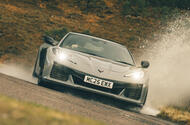
It might, you know. And in any variant of the current C8 generation of Corvette other than ours, you would also be carefully considering the wisdom of carrying on. Luckily the £153k E-Ray is a different kind of Kentucky muscle car. It still bears an atmospheric 6.2-litre LT2 V8 and is natively rear-driven, but it also has a dinky 1.9kWh battery in its spine. This supplies a 160bhp electric motor from Mitsubishi (a brand tie-up nobody saw coming) on the front axle.
So this is still a proper Corvette, just one that, for the first time in 73 years, has 4WD and is electrified. Keep the big rules so you can break the little ones – rule one being an enormous V8, here with 482bhp. Even peering over your shoulder is an event. There it is, low and down-lit by the sepia streetlight as we pass Glasgow in weather that shows no sign of letting up.
The first mini test in our goal of discovering if a Corvette can now be considered a true any-occasion supercar was the 320 miles of motorway to Gretna, where I collected Harrison. It was a solid showing as far as GT credentials go. The E-Ray returned a faintly heroic 32.1mpg while, according to the sharp central display, harvesting 4.1kWh and saving a pint of 98 RON.
The V8 was also a distant, polite presence and magnetorheological dampers for the double wishbones gave the car a heavy grace that played well with the cosy drama of the wraparound cockpit. The thigh bolsters of this 3LZ-grade car’s ‘GT2’ buckets are snug, but it’s a minor gripe. Even the Bose system is decent. For big miles this ‘Vette might just be the most accomplished mainstream mid-engined car on sale today.
Leaving our overnight stop at Loch Lomond early the next morning, the E-Ray pulls off its party piece, which isn’t an asbo-courting burnout resulting in smoke so dense you could cup it in your hands. The opposite, in fact. If you hit the brake pedal, neglect to press the engine-start button and twist the drive mode rotary, you can dial up Stealth mode. This will give you a few miles of electric running at up to 35mph and, as such, the ability to leave home or hotel silently.
Electric range thereafter is admittedly meagre: the E-Ray isn’t a plug-in hybrid, unlike efforts from Lamborghini, Ferrari and McLaren. But Stealth mode is still a handy gimmick. In normal driving the battery recharges through regen braking and coasting, and while it’s possible to exhaust the supply of electrons on a hot lap of a long circuit, during our Scottish odyssey there’s never a moment where brisk e-power isn’t on tap.
From Loch Lomond, our itinerary will soon take us up the A82, with its sweeping Macbeth landscape, to Fort William. We will then bear west at Invergarry along the fast, sumptuously well-surfaced A87, which clings to high valley sides and pipes you through fiery corridors of autumnal larch.
At Strathcarron we will hit the more technical, scrappy A896 to see if the portly E-Ray isn’t merely a straight-line slogger. Is there genuine magic in the handling? Has Chevrolet used electrification to actually enhance the fun? We will see. Our journey will then end at Loch Ewe, halfway up the mainland Hebridean coast.
Loch Ewe isn’t an entirely random choice. At 73m it’s one of the deepest sea lochs on the Atlantic, so if the E-Ray ultimately disappoints we will simply push it off the jetty and fly home. Of course we won’t. Loch Ewe is significant in our story because it was the main staging point for the Allied Arctic convoys that supplied Murmansk in WW2.
Submarine-hunting ‘corvettes’ defended these convoys from U-boat attack, the name having first been used by the French in the 1600s and then revived by Winston Churchill when he was running the Royal Navy. Fast forward to 1952 and it was Chevrolet PR assistant Myron Scott who, flipping through a dictionary in search of inspiration, hit upon the C-word.
He pitched it to the marketing team, which had by that point considered hundreds of not-quite-right names for an upcoming, fibreglass-bodied sports car. They loved it, and how could they not? So that is how the Corvette got its name: from fast, agile WW2 warships made on Tyneside. The fact that our E-Ray is painted flat battleship grey is pure coincidence.
6am: back to Loch Lomond. The roads are partly submerged by the overnight rain. There would be little hope of getting to know even a middling hot hatch in a dynamic sense, let alone a 634bhp monster, so all that’s left is to engage Wet mode, get comfy with flashes of aquaplaning and make progress towards Fort William. Short of fresh snow, this is as challenging an environment as you will get for something like a Corvette E-Ray, yet the car is remarkably manageable.
Its hulking 1920kg and its languid damping in the softest of the three maps make it more authoritative in such conditions than any drumskin-taut McLaren. Meanwhile, the steering is hefty and synthetic by class standards, with a lack of self-centring. But it’s calmly sped and immune to the twitchiness that makes supercars tiring on treacherous roads.
All of which puts a question mark over the E-Ray’s potential for A-grade thrills later on – but right now makes it as easy-going as a BMW M8 Competition, which is fine and dandy by me. And make no mistake, there’s genuinely good security underwheel. On a series of soaking roundabouts I can’t help but gradually up the ante and am surprised how well the Michelin Pilot Sport 4S tyres put power down on exit (as well they might, at a Ford Mustang GTD-matching 345mm!).
The electric axle gently but determinedly helps you stay aligned. It’s early doors, but the E-Ray already makes its case.
By Fort William, where we stop to replenish the car’s generous 70-litre fuel tank, the rain has ended. By Invergarry there are, for the first time in what feels like days, a few golden rays peeping through the greyness. The gorgeous, race track-esque A87, scribbled across the landscape, is also nearly deserted. Having waited for this moment, I get ahead of myself and swivel the drive mode rotary from Tour to, naturally, Track and prepare to uncork 634bhp.
Because why the hell not? Let me tell you why: Track mode is comically overwrought. The steering is like a deliberate caricature of a Can-Am racer’s and the damping is impressively but psychotically unyielding. In the UK you will last at most 30 seconds before admitting defeat and opting for Sport instead.
You can, of course, cook up your own mode. This is nothing new, but do your homework: it gets complex. With MyMode you can set and forget a combo for the exhaust valving, steering weight, damper rates, throttle progression and brake feel. But there’s also Z mode, named after Zora Arkus-Duntov, the Russian engineer who is part of the Corvette firmament. As ever, Z mode is activated via a metal button on the plush, if quite odd, quartic wheel with its droopy spokes.
Now you get the customisation of MyMode but can also tune the stability/traction control, for which there are no fewer than seven presets. Surely only the new 911 GT3 RS, with its thousands of damping set-ups, has more mode permutations.
I’m sticking to Sport. And now, on faster roads, the E-Ray begins to show its dynamic character. Throttle response has a burly roundedness about it but is still rewardingly sharp. In fact, tip-in feels just as you would imagine of a machine pushed by a bare-chested, crossplane V8 and also, to a lesser but instant extent, pulled by an electric motor (which weighs 39kg and is rugby ball-sized). It feels more natural than it sounds. Pedal travel is then lavishly long.
And the way propulsive force builds, though over too soon with a ceiling of 6500rpm, is unfailingly linear. It will feel too linear by far for forced-induction junkies, who will rue the fact the E-Ray doesn’t pin its ears back sooner, but they can stick to turbo-nutter super-saloons. Or wait a few months and shell out £50k extra for the new 911 Turbo S…
In truth, there is a notable lull between the promise of that initial pick-up and the arrival of meaningful torque. Here the E-Ray momentarily feels every kilo its class-busting weight. But by 4500rpm the V8 is making its peak of 452lb ft, swollen to 595lb ft by the electric motor, and you’re away. Prodigiously, thunderously away. To get the beans in an E-Ray you have to push the pedal through what feels like a 120deg arc, and getting it to the bulkhead is a deliberate, provocative act.
In all honesty it could be more provocative. There’s almost too much traction here for the driver who wants some mischief. Plenty of ‘all-season supercar’ points, though.
For the E-Ray, Chevrolet has also engineered a whining soundscape that arrives for the final 1000rpm. Notionally this is a pretty tragic idea in a car blessed with a soulful V8, but the reality is strangely effective. As Harrison grudgingly observes, it sounds a bit like straight-cut gears. On the subject of noise, on very good surfaces you can just make out the sound of the e-motor recuperating energy under braking. It’s a subtle bit of genuine mechanical theatre.
The carbon-ceramic brakes are excellent too: firm and precise enough for you to shed small increments at great speed with a precise brush of the pedal. But what you notice most, as your inputs ask more of the E-Ray, is how cohesive the most complex ‘Vette in history feels. It is robust and reliable. Not the most agile but steadfast and unflustered. If I had to stick my neck out, I’d also say it rattles and creaks less than its mid-engined rivals on coarse roads.
The super-saloon comparison is an interesting one because this E-Ray has something of the breed about it. Good balance, absorptive, fluid direction changes, an ability to carry speed effortlessly. It’s also well isolated, and we can get two overnight bags and Harrison’s smaller kit bag in the wide bin behind the engine (he’s got another bag in the frunk). Even the dual-clutch ‘box is quite super-saloon. It’s fine but lacks laugh-out-loud vivacity.
We stop to refuel again at a quaint station on the banks of Loch Carron. It’s a divine setting. It also gives me the chance to have a good poke around the E-Ray for the first time since leaving London. Carbon wheels! Enjoying yourself in a car this wide means forgetting about the cost of replacement, though as an owner I’m not sure I could ever achieve a state of such ignorance. Equally obvious is that the E-Ray is based on the wider of the two C8 chassis that Chevrolet offers.
The basic Stingray is on the narrow version and looks a bit toyish. For the E-Ray and the unhinged 206, the volumes around the rear haunches are tighter and more predatory. The aesthetic isn’t elegant, but gosh it has presence and it appeals to your fun-loving side. Knowing these cars are so much more sophisticated inside than old versions, with smooth leather, cold metal, mostly sensible ergonomics and truly Germanic levels of perceived quality, helps their cause.
You forgive the childish exterior. Having never really imagined owning a Corvette, the way this one covers ground in tawdry conditions, and its effortless, massive, distinct character… I like this car a lot.
But the arc of this tale demands a momentary stumble. So here it comes. The Corvette E-Ray is monumentally capable – assured and rapid – along the broad, sea-lined A832 that finally brings us to Loch Ewe and the Nato refuelling base that is its last military vestige. But we take a detour onto more technical roads, to explore how it handles tighter corners and switchbacks.
These are the kinds of bends a Ferrari 296 GTB would dive into and then sling itself out of with an easy opening of lock on exit as its limited-slip diff, quick steering and precision powertrain intuitively combined to heavenly effect. The ‘Vette is simply not that calibre of performance car. At 2722mm its wheelbase is a touch long, and its rear contact is too obdurate – too effective.
Neither does its suspension translate for you, via the steering, the alchemy of grip, pitch and yaw, guiding your hand with castor, as an Artura or 911 does. The E-Ray has all the traction you would ever need but not quite the dexterity you want. And while, when the road gets choppy, it largely avoids the twitchiness of the fancier, lighter, mid-engined Europeans, it also lacks their deftness.
But then it’s as much as £100k less. And is more practical and soothing over distance. And is easier, trustier company on days like today.
I realise the E-Ray has been reminding me of something. It’s the mercurial tri-motor Honda NSX. Yes, the one made in Marysville, Ohio, just a five-hour drive from Bowling Green, Kentucky. The difference is that the E-Ray has a clearer identity than the curious NSX did. Its job is to be a Corvette, only hybrid – and make no mistake, it’s a job done well.
Electrification might have sullied the V8 DNA and undermined the GT credentials Chevy has preserved in the mid-engine format, but none of it. For a weight penalty of 7% or so, e-AWD simply makes huge performance more exploitable. The E-Ray is a real all-season hero, and maybe the most complete Corvette to date.