
Geely-badged cars are new to the UK, but the brand is a volume-selling powerhouse at home in China
Until quite recently, Geely has been something of an automotive shadow in the UK, a background entity known mainly for its ownership of a number of familiar car makers.
Volvo, Polestar, Lotus and LEVC are among its portfolio of brands, and they have received substantial investment (with varying degrees of success). But in China, Geely is a prominent firm in its own right it has been making cars there since 1998, and it appears to have more resources at its disposal than some small countries.
Geely Auto launched in the UK at the tail end of 2025, aiming itself squarely at the mass market with a two-pronged BEV and PHEV approach. The UK business is currently building itself up, but back in China its HQ in Hangzhou employs 6000 people alone and is a hive of activity. Geely has a huge spread of brands covering luxury, budget, sport and even motorcycle sectors.
Having so many fingers in so many pies means the firm has bases of operation all over the world in Sweden, Italy, Germany, the UK and more that can be used for design, engineering, development and manufacture.
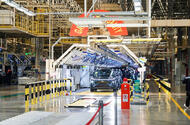
In China its factories are many and they’re huge. It might not come as a big surprise that a car firm’s manufacturing facilities are extensive, but there’s large, and then there’s what Geely has going on. A tour of its Linhai facility was mindboggling: the massive plant has an annual output of 300,000 cars and room to expand if desired, and its job is solely to build the Starray EM-i. It’s all hustle and bustle, but it’s not necessarily humans that are busy – the automation on display is eerie.
It’s not a huge stretch to imagine that the human element of the Geely construction equation will be mostly gone in the not-too-distant future.
To put its scale in perspective, Geely sells more than 50,000 EX2s (badged locally as the Xingyuan) per month in China alone, with more going elsewhere – soon to include the UK.
For comparison, Mini sold 162,789 Coopers (three-door, five-door and Convertible) globally in 2025. There’s a price difference, sure, but it’s an eye-opening number. In the UK, Geely plans to sell 100,000 cars per year by 2030, but only a portion of those will be EX2s; last year, it sold 4.1 million vehicles globally.
Michael Yang, Geely Auto UK’s boss, suggests that should demand, conditions and finances align, Geely could use its UK manufacturing base to build vehicles locally. The firm recently mooted it could build cars in Volvo’s US factory to bypass import tariffs, so the idea isn’t beyond the realms of possibility.
Building the cars is one thing, but developing them is another. Alongside its global R&D facilities, Geely has built itself a new safety centre and wind tunnel complex at a cost of more than £200 million. Many car companies have wind tunnels, but most don’t have three in the same building.
Geely has one for 155mph gusts, temperature ranges of -40deg C to +60deg C, and sun and rain simulation; one for 124mph gusts and altitude simulation of more than 5200 metres; and the third as a spare.
In the same building you will find climate rooms to bake, soak and freeze cars to see what happens to them. Geely isn’t keeping all of that to itself, though it says the facilities will be ‘shared’ with others.
On the same site is a new state-of-the-art safety testing facility. There you will find a range of crash test dummies designed to simulate all the members of a family, a room with various run-ups to simulate crashes, spaces to test ADAS sensors and even a cybersecurity test room that looks charmingly like a Bond villain’s lair.
Geely is giving all the right messages about sustainability, too. “We’re very sustainable,” says Ash Sutcliffe, Geely Holding’s global PR chief. “Nothing gets wasted in China; if anything can be reused, it will be reused. I think our cars have about a 97% recyclability rate.
“Once the car reaches end of life, we take it all back and put it back into the system.” A cynic would roll their eyes and say ‘of course they’d say they’re sustainable…’ but the air around the Linhai factory, while still a little hazy, was nowhere near as smog-like as it can be elsewhere in China.
Geely’s scale shouldn’t be a surprise, but touring its mammoth facilities is still instructive. The rate at which Geely can react to changes, deploy resources and build cars is quite something. And in the same breath that something should be a concern for car makers in the West.
The message is clear: Geely is coming and it isn’t expecting to fail.