
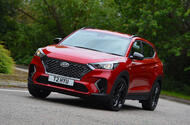
No-nonsense, roomy Tucsons are plentiful, practical and affordable – but potentially unreliable
Launched in 2015, the third-generation Hyundai Tucson quickly became a family favourite SUV in a fiercely competitive segment – and the firm’s best-seller in Europe.
Which is good news for today’s used buyer, because it means there are plenty of them on offer in the classifieds.
Sift through them diligently – there can be reliability issues with some, as we will explain – and you can bag yourself a practical, well-equipped, cavernous bargain.
The Mk3 Tucson line-up is relatively straightforward to decipher, with a range of pure petrols and diesels, plus a 48V mild hybrid. All engines are ULEZ-compliant, but there are no full-hybrid or zero-emission variants.
At launch, there was a choice of two ‘Gamma’ 1.6-litre petrols: a naturally aspirated unit with 133bhp and a turbocharged version with 174bhp. On the diesel front, buyers could pick a 113bhp 1.7-litre or a 2.0-litre with 134bhp or 181bhp.
All engines came as standard with a six-speed manual and front-wheel drive except for the 181bhp 2.0 diesel, which was four-wheel drive only. The 134bhp 2.0 diesel offered 4WD as an option.
A seven-speed dual-clutch automatic was optional on the 1.7 diesel and a conventional six-speed automatic could be paired with the two 2.0-litre diesels.
No variant is bad, but we would avoid the petrols: the atmo 1.6 can feel sluggish, the turbo version is on the thirsty side and there are reliability concerns (see Buyer Beware, right). Of the diesels, the 1.7 is our pick because it is notably more refined than the 2.0 units and offers adequate grunt for everyday use with decent fuel economy.
All Tucsons offer plenty of space. Front and rear passenger room is excellent and its 513-litre boot is nearly 100 litres larger than a Nissan Qashqai’s, although you won’t get the perceived material quality on offer in the Qashqai. But you will get an impressive roster of equipment. All versions come with autonomous emergency braking, LED daytime-running lights and reclining rear seats, while some have luxuries like ventilated cushioning and adaptive cruise control.
Trims begin with S and rise to SE and SE Nav, with Premium topping the range. There was also a Sport trim with big wheels, which don’t help the ride.
In 2019, Hyundai broadened the range with a light facelift. The petrols were carried over. Little changed, but the turbocharged variant gained the dual-clutch automatic as an option.
For the diesels, a 1.6-litre replaced the 1.7 and could be had with 113bhp or 134bhp, with the option of the dual-clutch ‘box in the higher-powered variant. The 2.0-litre diesel became four-wheel drive and auto only, gaining a slight power boost to 184bhp courtesy of a 48V mild-hybrid system.
As for equipment, a larger infotainment screen, Apple CarPlay and Android Auto, and a 360deg camera all became available. If you’re worried about reliability concerns hurting residuals in the long run, prices are already quite cheap – starting at £4500 – and there are enough examples out there to find a well-looked-after one.
Our pick, a 1.7-litre CRDi with a manual gearbox, is the cheapest one today because buyers are cautious about diesels. And road tax (VED) will be just £35 for those registered before 1 April 2017.
What to look for
Engine: The 1.6-litre ‘Gamma’ petrol engine has a poor reliability record. We spoke to a Hyundai/ Kia mechanic who advised avoiding it because it’s not uncommon for piston rings to fail at 50,000 miles – the telltale sign is excessive oil consumption – resulting in the need for a replacement engine. Owners suggest changing the oil every year or 5000 miles, instead of the two years and 20,000 miles recommended by Hyundai, but that isn’t foolproof. Glow plug faults are common on the 2.0-litre diesel. Expect to pay £1500 for a fix.
Diesel Particulate Filter: On diesels, the DPF can be an expensive problem. An illuminated warning light may indicate a failure to regenerate or the AdBlue injector failing. Either issue can cost thousands to fix. To help prevent problems, regularly undertake a reasonable motorway drive. Also note that pre-facelift Tucsons do not have AdBlue.
Gearbox: The synchromesh in manual cars can prematurely fail, requiring a replacement gearbox. Look out for noisy, difficult changes. Dual-clutch cars are prone to getting stuck in gear.
Four-wheel drive system: The rear driveshaft can fail on 4WD Tucsons and it isn’t a cheap repair. If left unresolved, vibrations may damage the gearbox and leave it irreparable.
Electrics: They’re temperamental at best. Door locks, handles, window switches and electronic parking brake switches often fail. Parts from Hyundai for a handbrake switch cost as much as £550. ABS, traction control, engine management and auto hold lights are reported to be regular dashboard features, often requiring a new sensor. Sat-navs are easily confused about where they are currently located and some owners have reported the screen delaminating.
Also worth knowing
Rivals such as the Mazda CX-5 and Renault Kadjar are ultimately better-rounded but are pricier, so the Tucson is something of a bargain for the space on offer. The split in the classifieds is slightly in favour of the petrols, while one in five is an auto and just one in 10 is 4WD. Even so, there is a good number of all variants available.
An owner’s view
Michael Kemmet: “I’ve owned my 2016 Tucson 1.7 CRDi for over seven years. The only expensive bill I’ve had was for a new electric handbrake switch, at over £300, not including labour. My other costs have just been normal wear and tear items. Overall, the car has been brilliant, including towing our caravan on all our holidays. I’m aware that other owners have had far worse luck, but I know the diesels are more trustworthy. Nevertheless, I have an oil change every year or around 6000 miles for peace of mind.”
How much to spend
£4500-£5499: Early, low-spec cars with a six figure mileage and worn-looking exteriors and/or interiors.
£5500-£8499: A broad range of pre-facelift cars with 50,000 to 100,000 miles under their wheels and some in desirable Premium specification.
£8500-£12,499: Plenty of facelifted models and low-mileage pre-facelift cars.
£12,500-£20,000: Top-spec, low-mileage 2019, 2020 and 2021 Tucsons. N Line and Premium SE mild-hybrid diesels are the dearest.