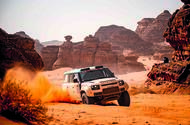
After five decades, the Dakar Rally has finally attracted a works Land Rover entry
The Dakar Rally bivouac is a vast, sprawling, transient community, a ragtag collection of vans, trucks and tents sprouting from the hardscrabble Arabian Desert.
Walking through the camp is like stepping into the world of Mad Max, a disparate cast of thousands tending to a bewildering array of outlandish vehicles, from bikes to buggies and lorries.
But in the middle of that camp for this year’s Dakar, there was a little oasis of organised, efficient and very British calm: the service area for JLR’s new Defender Rally team, which made its competitive debut on this year’s endurance classic as the start of a three-year commitment to the full World Rally-Raid Championship (W2RC), which includes four other events.
The Dakar Rally, of course, no longer starts in Paris or goes anywhere near the Senegalese capital: it’s now run entirely within Saudi Arabia.
You can have valid moral objections to holding the event there (as with the many other sporting or cultural events the Gulf state now hosts in a bid to burnish its global image), but you can’t argue with its suitability for a rally raid: the vast desert landscape provides plenty of options for the near-5000 competitive miles covered on the 15-day marathon event.
This year’s event started and finished near the Red Sea port city of Yanbu, passing near the capital of Riyadh en route. While the Dakar is a hugely competitive event at the sharp end, for the bulk of the 600-plus competitors (split among cars, bikes, buggies, trucks and a fast-growing class of classics), it’s really about a sense of adventure.
In that sense, it’s a natural fit with JLR’s plans to turn Defender from a Land Rover model line into a standalone premium brand focused on rugged adventure.
“When we set up Defender,” says brand director Mark Cameron, “one of the earliest conversations I had was ‘wouldn’t it be a cool thing for us to go and compete as a works team at Dakar for the first time in the history of Land Rover or any of our brands?'”
Indeed, while plenty of Land Rovers have competed on the Dakar in years past, the three Defender D7X-Rs that tackled this year’s event were the first fully works-run machines in the near-50-year history of the event.
JLR’s initial three-year commitment to the Dakar includes becoming an event partner as well as contesting the W2RC. But no matter how committed the manufacturer is, it won’t yield an outright victory: its team is firmly focused on the revamped production-based Stock division, rather than joining Toyota, Ford and Dacia chasing outright glory in the T1+ class, which is dominated by bespoke, spaceframe racers.
“We had no interest in the T1+ class, because we wanted to draw the parallels with the road and rally cars,” explains Cameron. “That’s the whole reason we’re here. We wanted to take the Defender Octa – our toughest, meanest, highest performance production car—and create something that connects with it.”
There was a problem: the regulations for the production car class, known as T2, weren’t, as Cameron puts it, “fit for purpose”. They hadn’t been updated for 20 years and didn’t reflect modern production cars, causing interest to dwindle.
Dakar organisers worked with a range of manufacturers – including JLR, Toyota and Ford – to overhaul them, creating the new Stock category. The new rules essentially allow for production-based cars featuring their original powertrain, albeit with performance pegged using a set power-to-weight ratio, with limited modifications allowed to ensure they are capable of conquering Saudi Arabia’s tough terrain.
The key to the class is that it allows for different vehicle concepts: the Toyota Hilux pick-ups that have dominated the T2 class for the past few years have featured body-on-frame construction, whereas the Defender has an aluminium monocoque body. Cameron admits that a huge part of the appeal was for JLR to prove that a monocoque 4×4 could handle hardcore off-roading as well as a traditional ladder-framed one.
Building a Stock racer
The Dakar Defender D7X-R really is a stock machine: the bodyshells of the rally cars were made on the standard road car production line in Nitra, Slovakia.
“All the stampings, the pressings, everything that went into this car is exactly the same as you would get if you bought a Defender 110,” says Jack Lambert, the project’s head of technical integration. He essentially serves as a conduit between JLR and leading preparation outfit Prodrive, which builds and runs the cars.
“We worked really closely with the team at Nitra, because the regulations said we could make small modifications to the body so it could cope on the Dakar,” Lambert continues. “But it’s very difficult to make those modifications once the adhesive has cured and the bonding is done. They build these bodies specially on weekends so they can turn certain robots off so they don’t pick up some parts. So everything is done to production standard but it’s a rally-ready body.”
Those bodies are then shipped to Prodrive’s Banbury base, where they’re hand-built into the rally cars. One element that remains largely untouched, though, is the powertrain: the base car is the Defender Octa, with its 4.4-litre twin-turbo V8 driving through an eight-speed automatic gearbox. But because of the rules governing power, a restrictor limits the D7X-R to 390bhp, compared with 626bhp in the Octa. The final gear of the ‘box has been lowered, too, because of the slower speeds on off-road events.
So what has changed? The suspension, for starters: it has to retain the “kinematic principles” of the original car but can be beefed up to cope with rocky terrain, notably featuring twin Bilstein dampers on each rear wheel. There are mighty 35in off-road tyres and the track has been widened: the D7X-R has a front track of 1832mm, which is 60mm wider than the Octa, which in turn is 68mm wider than a standard Defender 110. The suspension and subframe mounting points remain as standard, though, with an exoskeleton for extra strength.
The drivetrain retains a central transfer case, which controls the four-wheel-drive system. The road-going Defender essentially offers permanent rear-wheel drive but with a slip clutch allowing power to reach the front axle. The front and rear differentials have to retain the production casing, but JLR is allowed to change the internals of them. Notably, the rear e-differential has been ditched for mechanical limited-slip diffs on both axles.
“The e-diff is all about bandwidth of capability,” explains Lambert. “It makes the car incredible on and off-road. We don’t need that: we just need it to be really solid off-road.”
The drivetrain software for the rally car is also bespoke. “On the road, it’s always balancing both axles to give you amazing on-road drivability and off-road capability,” says Lambert. “We don’t need that: we need this to be four-wheel-drive and slide around corners. So we just add pressure to the clutch pack in the transfer case, wind it up and limit the front axle torque.”
Another software addition is “flight mode”, which automatically adjusts torque to the wheels when the car is airborne to ensure a smooth landing that protects the drivetrain.
The bodywork has to follow the standard template, but the front end has been reworked to add substantial extra cooling, the road car’s single radiator being replaced with three units, assisted by four fans to blow hot air away faster. The interior has also been extensively reworked, including a full roll cage.
But despite this being a big SUV, there isn’t much room in the back: Dakar rules require a massive 550-litre fuel tank, which takes up most of the boot and rear seat space. Three spare tyres are also crammed in, along with a tool kit including compressed air and integrated hydraulic jacks.
The D7X-R is a bit of a beast, basically. And much as it’s a road-legal stock car, it’s very much a full-on competition machine and the result of considerable work between JLR and Prodrive. It certainly looks the part in action: although it has around the same overall power as the vehicles in the Ultimate class, the Defender’s heavier production-based body and less aggressive suspension means it simply can’t match up on a rally stage.
And while it fared well in its Stock class, the opposition amounted to a quartet of privately run Toyotas and Nissans. That hasn’t put JLR off, though: it has made a three-year commitment, and Cameron is already eyeing staying an extra year, for the 50th anniversary of the Dakar in 2029. And the hope is that the Defenders will face a far harder time in the future, as more manufacturers are hopefully drawn to the Stock category.
“We want competition,” Cameron says. “If you’re only racing yourself, you’re always going to win. In motorsport you need competition. And from being here and the interest in the bivouac, I think in a few years there will be a healthy field of other manufacturers wanting to play with us.”
How did the Defenders fare?
Given their opposition amounted to a smattering of privately entered Toyotas and Nissans, the Defender squad was always likely to dominate the Dakar Rally’s new Stock class – and a clean sweep of stage wins is proof that it did just that.
If there was a surprise, it’s that it wasn’t Dakar legend Stéphane Peterhansel leading the way: a technical problem cost him nearly an hour on the first stage, before a snapped alternator belt on the eighth test ended any slim hopes, restricting him to fourth in class.
Instead, 26-year-old Rokas Baciuška dominated, taking a lead he would never lose on the first proper test and avoiding any major dramas on his way to the biggest win of his career by nearly four hours. Sara Price also took three stage wins on her way to second in class.
Crucially, despite suffering various mechanical issues, all three D7X-Rs made it back to Yanbu for the finish of the event.