The appeal of the Mazda 2 grows more and more as prices become cheaper and cheaper
Most mainstream cars have life cycles of seven or eight years, even in today’s fast-paced environment – which means the third-generation Mazda 2 was one of the UK’s oldest cars when it bowed out in 2025 after more than a decade on sale.
More impressive than its longevity, though, is its enduring appeal. When it was new in 2014, we liked it a lot and 10 years later, we still liked it a lot, maintaining its four-star verdict and saying: “The Mazda 2 remains something of a hidden gem for supermini buyers and it now also feels like a proper throwback of the finest type.”
It still feels fresh today, making it the automotive equivalent of one of those ads you see for anti-ageing medications: “Doctors hate the Mazda 2 for this one simple trick!”
So what’s the secret? It’s starting with a solid base and then nipping and tucking through the years.
The 2 has always been a great drive, and when Mazda switched from a Ford Fiesta platform to its own architecture for the Mk3, we had high hopes it would continue to excite in everyday driving. We weren’t disappointed.
True, it’s not quite as chuckable or nippy as a Fiesta, but it’s oh so close and definitely gives the Mini Cooper a run for its money down a twisty road. It’s also comfortable, staying composed over road surface flaws.
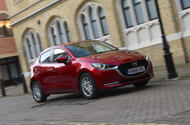
It looks smart too. Even pre-facelift cars appear modern, while the brightwork of the 2019-2022 models adds an upmarket air and the last facelift in 2023 brings a sporty edge to the design.
Bolstering the 2’s enthusiast credentials is a cabin layout that echoes the Mazda MX-5’s, with a similar driver focus, good use of materials and analogue controls. It’s a place you will enjoy spending time in. Depending on the car’s age, there’s a 7.0in or 8.0in touchscreen (which can also be controlled using a rotary dial – huzzah!) and all the accoutrements you could expect.
Phone connectivity is included on cars from 2019 onwards. Space is good up front, with lots of elbow room, but in the back, tall adults will be more squashed than in a VW Polo, and the tight boot has a capacity of just 280 litres when most rivals are well into the 300s.
As for engines, Mazda is an advocate of normal aspiration and the main choice is a smooth 1.5-litre petrol four that’s charismatic and reliable. Even the least powerful 74bhp version with a five-speed manual feels peppy enough. The 2 weighs only a hair over a tonne, so 100lb ft feels plenty. The 89bhp version is nice to have, because it also gains a useful bump in torque.
Some cars have a six-speed automatic (it was optional), but it dulls the performance and fun factor. Besides, the manual ‘box has one of the best throws out there. The 114bhp tune doesn’t add any torque, but its manual’s sixth gear is welcome on the motorway and the 8.7sec 0-62mph time helps to make it feel like a warm hatch.
With the 2019 facelift, the 89bhp version gained a six-speed manual and, alongside the 114bhp variant, a mild-hybrid system that boosts economy, if not performance. Talking of which, a real-world mid-50s to the gallon is achievable.
Road noise is pronounced on motorways (facelifted models have extra soundproofing), but the 2’s blend of style, rewarding driving dynamics and impressive reliability record makes it a compelling choice, even against newer rivals.
What to look for
Suspension: Some owners have reported prematurely worn suspension components, specifically shock absorbers and bushings, particularly on earlier models. Listen for any excessive knocking or squeaking over speed bumps and check the shocks for any visible fluid leaks.
Brakes: On cars driven in a spirited fashion, the front brake discs can be susceptible to warping, causing a telltale shuddering under moderate braking. This is often fixed by simply fitting high-quality replacement rotors and pads, which is a sensible upgrade anyway.
Air conditioning: Failures or poor performance of the air conditioning system have been noted, often due to a refrigerant leak. Check the air is blowing icy cold. If it’s weak, it could be a costly fix beyond a simple regas.
Infotainment: The system is generally intuitive but can occasionally freeze or reboot itself. A simple software update from a dealer usually sorts persistent issues, but it’s worth checking its functionality during a test drive.
Also worth knowing
As well as the 1.5-litre petrol, there’s a rare 1.5-litre diesel, available in pre-facelifted cars. It’s relatively powerful (104bhp and 184lb ft) and is the sole turbocharged 2. If you want something small to do a lot of miles in, it holds appeal and you can expect to average 70mpg. But on the downside, refinement takes a further hit and the extra weight affects the handling and ride.
Every 2 registered before 1 April 2017 will be £35 or less to tax per year, while all cars after that will come in at £195. The early line-up featured SE, SE-L and Sport Nav trims, all of which are well equipped. Later trims, such as Sport Nav and GT Sport, added niceties like a head-up display and LED lights, but it’s worth checking the spec of any 2 you’re looking at carefully, because there was a wide range of trims over the years with changing levels of equipment.
From 2022, Mazda also sold a hybrid version called, helpfully, the Mazda 2 Hybrid, but it’s actually a rebadged Toyota Yaris. So don’t confuse the two: the Mazda-designed 2 (the one you want for driving pleasure) was still sold alongside it.
An owner’s view
Sarah L: “I bought my 89bhp SE-L Nav three years ago as a runabout, and I’ve loved it far more than I expected.
“The gearchange is sublime and it just feels light and agile compared with every other supermini I test drove. It never fails to put a smile on my face.
“Economy is great: I regularly hit over 50mpg. I’ve only had routine servicing done and the only minor grumble is that the infotainment screen can sometimes be a bit glitchy, which I just fix by turning the car off and on again.”
How much to spend
£3000-£7999 Everything from high-mileage heroes (some with more than 150k) to barely run-in early cars.
£8000-£11,999 First-facelift cars (from 2019) make up the bulk at this price point, with a wide selection of mild hybrids and autos.
£12,000-£20,000 Lots of two-year-old, 40,000-mile second-facelift cars (from 2023), up to ex-demos with mileage in the hundreds.