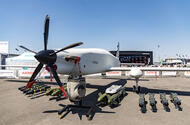
Renault has begun building drones for Turgis Gaillard in Le Mans
Business lost to the influx of Chinese rivals and the shift towards EVs has sparked a pivot from makers
The European car industry is seeing opportunities to expand in the growing defence sector as a way of replacing business lost to both the shift to electrification and the influx of Chinese manufacturers.
In the most prominent example, the Renault Group has opened up its component factory in Le Mans, France, to build strike drones for military contractor Turgis Gaillard. “It is an opportunity business,” said the car maker’s CEO, François Provost, adding: “We have one concrete project and there are a few other [defence opportunities]. Let’s see”.
With Nato under threat due to strained relations with the US, European countries are increasing their defence budgets to better be able to tackle the threat to its security from antagonists such as Russia.
At the same time, job losses within the automotive industry are at a record high as car makers and their suppliers try to cut costs in the battle to match the competitiveness of Chinese companies.
“It has been an unbelievably challenging four years for the industry,” Christophe Périllat, CEO of French super-supplier Valeo, said in November last year after revealing plans to “apply our technology to a broader range of related applications”, including defence.
In the UK, the Society of Motor Manufacturers and Traders (SMMT) recently hosted a meet-the-buyer ‘speed dating’ session designed to introduce the Ministry of Defence to automotive suppliers looking to branch out in order to protect their businesses against any future shocks.
“The MoD attended that with fairly low expectations, I think, but came out actually saying ‘we can do a lot here’,” said SMMT CEO Mike Hawes. “If that’s a business opportunity for automotive and there’s some crossover, then we want to encourage that”.
The leap between developing and building parts for cars and military vehicles isn’t huge, and many companies already combine the two. For example, British brake firm Alcon supplies both race and specialist road cars as well as armoured vehicles for the likes of Supacat, BAE Systems, Ricardo and Jankel. Ricardo itself is another supplier with a foot in both camps. The builder of McLaren road car engines also developed the Foxhound armoured patrol vehicle (formerly called the Ocelot) that replaced the British military’s Snatch Land Rovers from 2011.
Even car factories are being eyed for defence work. In Finland, contract manufacturer Valmet – famous for building cars for Porsche and Mercedes-Benz – announced in December last year that it had signed an agreement to build armoured vehicles for compatriot firms Sisu Auto and Patria. The new work will replace business lost when Mercedes stops production of the current A-Class.
Meanwhile in Germany, reports last year suggested Volkswagen was talking with the country’s largest arms maker, Rheinmetall, to build tanks at the car maker’s Osnabrück plant, which is scheduled to close. In 2024, Rheinmetall signed an agreement with Continental to retrain workers laid off by the German supply giant.
This isn’t a new venture for those car makers with a long enough history, however, as they were almost certainly an important part of their home country’s military industrial complex during the course of WW2 or even WWI in the case of Renault. Bentley‘s Crewe HQ and Jaguar’s Browns Lane plant in Coventry, for example, both started life assembling war plane engines.
The move won’t suit every company, though, warned Hawes: “It’s a very different business. You’re going from the volume business to something much smaller. But it’s about longer-term contracts”.
The attraction will be the certainty of a government deal versus the worry that, as a supplier, your automotive business is shrinking. Even existing contracts with car makers are being ripped up with a frightening frequency these days after another multibillion bet on the future direction of automotive goes south.
Renault’s drone deal is more opportunistic than a strategy, explained Provost: “It’s not part of our new mid-term plan. We work based on contracts with the French ministry of defence. We do not intend to be a defence industry maker”. When you’re part-owned by the national government, as Renault is, you’re almost obliged to say yes when the state comes calling with such a patriotic request.
But Provost said that making weapons of war won’t be a distraction from selling mobility to the masses: “For sake of clarity, we will not allocate capital to defence that will decrease our attention to our core business, which is about cars”.