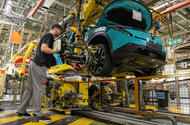
The new Nissan Leaf is among the UK’s few electric exports at present
Industrial Accelerator Act to lock British-built EVs out of European markets, with “catastrophic” consequence
The UK’s beleaguered car industry is facing a new threat from changing EU rules that have been dubbed “pretty catastrophic” and “gravely concerning” if they go through as proposed.
The Industrial Accelerator Act (IAA) is the EU’s response to threats to key industries including automotive and battery making, mainly from China.
In an impact assessment report, the European Commission noted the phenomenal rise in Chinese car imports into the bloc, up 380% in the first half of 2025, while those from the EU to China fell 50%. “This phenomenon represents huge competition for local manufacturers,” it said.
The problem for the UK is that post-Brexit we are also being treated as a “third country”, along with China, so will be locked out of key benefits for EVs made within the EU’s boundaries.
“In a worst-case scenario, the IAA could be pretty catastrophic. It could lead to a dramatic contraction of the UK auto industry,” said David Bailey, professor of business economics at Birmingham Business School.
What the EU has done is to create a series of benefits only available to electric cars made within the bloc. Those that are made in the EU will be included in state procurement lists (ie government fleets); eligible for new EV targets imposed on big corporate fleets; available for state purchase incentives; and eligible for the CO2 incentive that gives car makers extra credit for selling small EVs (those less than 4.2m long).
To be locked out of any one of those benefits would do significant damage to the UK’s nascent EV manufacturing, but the fleet exclusion would hurt the most, given that we mostly build larger models.
“Corporate fleets account for 50–60% of all new car sales,” Bailey said. “If the IAA passes in its current form, a company director in Lyon or Frankfurt might find that a UK-built car is significantly more expensive to lease than a French- or German-made rival, simply because the British car doesn’t carry the ‘Made in Europe’ badge.”
There’s a big ‘if’ here, because there’s some confusion over whether the UK is totally excluded or just locked out of the corporate fleets or small car credits. The proposal suggests the latter, with those countries with which the EU has a trade deal counting as of “Union origin”.
Nissan has interpreted this as a partial victory for the UK. “We’re pleased the Commission has addressed industry concerns and recognised how important partners are to the EU supply chain,” it said in a statement, while also criticising exclusion from the other two benefits because it creates “unnecessary complexity for the industry”.
However, an annexe to the proposal seems to contradict the main text, suggesting that EU assembly will be required to unlock all four benefits.
It also gets tough on battery sourcing, requiring least three battery components, including the cells, to be produced in the EU, rising to five in 2030.
Insider information from Brussels relayed to Autocar suggests this exposes underlying tension within the Commission, the annexes being a last-minute insertion by the team for Stéphane Séjourné, the hardline industry strategy commissioner, undermining the more dovish trade department.
The head of the UK’s Society of Motor Manufacturers and Traders (SMMT), Mike Hawes, described the IAA proposal as “gravely concerning” but also “poorly drafted” and called for immediate talks. “The UK government and European counterparts must work together urgently to resolve the situation,” he said.
Response to the proposal from the industry at large has been mixed. Renault CEO François Provost described the focus on local car makers as “common sense” while reserving further comment due to the complexity. Volkswagen Group CEO Oliver Blume described the small car credit benefit as “very helpful”, with the company’s Spanish-built small EVs (the Cupra Raval, Skoda Epiq, Volkswagen ID Cross and Volkswagen ID Polo) due to come on stream later this year.
Europe’s supplier association, CLEPA, was strongly supportive, calling implementation of the act “more crucial than ever” as the industry faces a financial crunch and continuing job losses.
BMW, on the other hand, isn’t a fan. Like rival Mercedes-Benz, it’s a global exporter and as such fears reciprocal action from China. “We do not believe in protectionism but rather in the power of innovation to compete on the global stage,” outgoing BMW CEO Oliver Zipse said.
Toyota has also criticised it. “Toyota strongly believes that for the EU to achieve its objectives, it should take an inclusive approach to leverage key partners within the EU and trusted partners with existing agreements outside the EU,” Matt Harrison, chief corporate officer for Toyota Motor Europe, said in a statement. The “trusted partners” he cited included Japan, South Korea, the UK and Turkey.
What happens now is a lot of wrangling in Brussels as the various parties thrash out an agreement that everyone is happy with – or least unhappy with. The UK won’t be the only country angling for inclusion in the “union-made” criteria, with Turkey, Morocco and Serbia fighting to protect car industries that also rely on the EU as their main market.
Last year, 57% of the UK’s car production was exported to the EU. Almost none was electric, but that will change as Nissan ramps up production of the new Leaf. Both Toyota and Mini will also need to decide whether to switch their plants over to EV making.
One line of attack being taken by the SMMT is to argue that the proposal is incompatible with the post-Brexit EU–UK Trade and Cooperation Agreement, although Bailey fears this was too narrowly focused on tariffs to be much use against a non-tariff barrier like the IAA.
The beneficiary will be the EU, potentially attracting fresh investment from car makers not willing to be shut out by the bloc in its newly protective mode.
“While aimed at slowing Chinese OEM penetration, the measures are likely to accelerate localisation decisions already under way, potentially driving higher investment into Europe,” Philippe Houchois, automotive analyst at the bank Jefferies, wrote in a note to investors.
Once again, however, the limbo means the UK is off limits for investment until the final version of the IAA is published and it’s known whether this huge barrier is lifted or not.
“You’ve got another big dollop of uncertainty, which is likely to impact investment in the UK,” Bailey said. “It’s going to affect the next decision on where a car maker is going to produce their cars, for example Mini in Oxford. It means the UK becomes a less attractive place to make cars.”