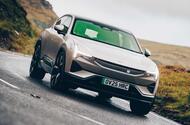
Stylish EV signs off, but has it been a fulfilling time or a frustrating one?
We’ve long been promised cars of quite different shapes and sizes thanks to the advent of EVs and the skateboard-style architectures on which they’re based. But instead we seem to have been treated to a series of slightly taller and visually uninspiring hatchbacks.
The Polestar 3, though, really is something different. In its profile and proportions, I’m struggling to pick a direct rival or even say what it reminds me of. It’s a taller estate car but with a sleek body, raised but definitely still sporty. It looks great.
In an office discussion, we once counted more than 50 different categories of car; the Polestar 3 would add another to the list.
The 3 is so called because it’s the third model Polestar has launched as a standalone brand. When I’ve told people I’m getting a 3, they’ve asked: “Is that the one without the rear window?”
No, that’s the 4. The 3 was launched at the same time as the 4. Given that the 4 is smaller than the 3 and the 2 is smaller than the both, it would make more sense if the 3 were called the 4 and the 4 the 3. But Polestar’s naming convention for now is sequential, in the order of launch.
The 3 was planned first, and rather than being the one without the rear window, it’s the one that’s both a sibling to the Volvo EX90 and Polestar’s new range-topper. This relationship with the EX90 means the 3 has been launched at the same time as the 4, and with that comes the naming confusion.
Volvo developed the new architecture of both the EX90 and the 3. It was delayed due to complexities in developing the software. When you first get into a 3, you can see why, because the Swedish engineers haven’t exactly kept things simple.
There isn’t a traditional key; instead there’s a credit card thing, attached to which is a little fob that acts as a proximity key – with no button to override it. You have to charge the fob on the wireless mat on the centre console, because if its battery goes flat, you’re in trouble.
Just two days in, I was locked out of my 3 at Heathrow airport after a night away. There is a trick to get in, though: you tap the door handle a few times within a certain timeframe. And after some trial and error, I was back in. Then for a few days, the car seemingly wouldn’t lock at all and the proximity function failed.
Polestar said to check the central touchscreen to see if a software update was due. It was, and the ambiguous and somewhat understated ‘general improvements’ promised in the small print did seem to solve things. The car has been okay since, but, oof, what a first impression to leave.
I’ve since added a back-up of a key on my iPhone, where it’s stored in the Apple Wallet app. It too acts as a proximity key, so now the 3 unlocks every time I walk past it with my phone. It’s quite unnerving, and it means I have to double-check that it has locked itself again once I’m past. But I can at least now get in and out of the car, so long as at least either my phone or the fob is charged.
It’s a shame that something that should be as basic as locking and unlocking the car has taken up so much space in this first report. Hopefully we can put it down to early software on a new car, solved by an over-the-air update.
It can’t all be that painful, right? Thankfully, first impressions are otherwise positive. This car looks great, drives nicely and is well equipped. Spacious, too. It feels like something different, and the lack of a direct rival adds to the intrigue.
Our model is as well-specced as 3s come: it’s a Long Range model with the Performance Pack. This gives it two motors (and four-wheel drive) with 510bhp instead of the standard 483bhp of non-Performance Pack 4WD models -all enabled by a software change, of course. So you get 0-62mph in 4.7sec. Rear-wheel-drive 3s are also available.
The Performance Pack adds 22in alloy wheels, Pirelli P Zero tyres, beefier brakes by Brembo, some sportier styling trim inside and out and a more dynamic chassis tune.
The battery is a whopping 107kWh (usable), which is offered on all 3s regardless of motor set-up. Our test car’s range is a quoted 348 miles, but even in warmer weather I’m getting nowhere near that – so far more like 250 miles. You wouldn’t expect Volkswagen Golf diesel economy from a BMW M5, but it feels like the 3 really should be more efficient than this. Head towards the single-motor RWD cars for greater efficiency.
I ran a Polestar 2 a year or so ago and found its Performance Pack pushed the car in a slightly unnecessary direction, with extra performance and a firmer chassis it didn’t really need at the expense of range. The 3 leaves a better first impression in its fruitier flavour, so this will be an interesting comparison to make over time.
The amount of kit otherwise included on my 3 fills a sheet of A4 (and in quite a small font at that). There’s so much of it, in fact, that despite a price tag nudging £90,000, it actually feels like quite good value compared with the likes of the BMW iX M60 – and the 3 is a much sweeter road car.
You really can sense the Polestar DNA in the way the 3 drives, which is something other electric car makers have struggled with. Blindfold me and I could tell you this is a Polestar; I can’t think of another manufacturer’s EV range in which I could do the same.
Now I can get in it, the 3 feels like another interesting development from a very interesting brand.
Update 2
While we report both fearlessly and with independence here at Autocar, sometimes conversations with interview subjects have to stray off the record, be it for background purposes or perhaps so an interviewee can make a point they can’t otherwise make while wearing their official hat.
One such conversation has to date sat unreported in my notebook, and frustratingly so. It has come to mind a few times during my ‘getting to know you phase’ with the Polestar 3, prompted by how the car rethinks and ultimately complicates certain things by digitising, rationalising, simplifying or even ruining some core functions.
The interview subject – who had no links to Polestar, so we’re on safe ground – told me long ago how their company was “pushing back on bullshit functions that are not things anybody needs, are over-engineered and are a nerd’s idea of finding progress to brag about”.
As I sent the 3’s digital key from my phone to a colleague so they could drive the car – the proximity-sensing physical key fob can’t always be trusted – those words rang in my ears. I also think back to them when I go into a menu to find a button to open the glovebox, fold in the mirrors or open the rear windows after forgetting to toggle a setting first because there are just two switches to operate four windows… The list goes on.
Is this progress? Did anyone ask for it? I’ll do my best not to stray into further ranting on the well-publicised issues of the 3’s and related Volvo models’ usability, but they frame so much of your experience with the car that they can be hard to ignore.
In the 3’s opening report three weeks ago, colleague Matt Saunders expressed hope that meaningful improvements would be made to the car and its usability with over-the-air software updates. One such update during my early days with the car focused on bug fixes rather than wider changes, while another has now presented itself to be installed. Let’s see.
When you are at peace with the settings and nothing needs adjusting, there is much to enjoy about the 3. I’ve piled on the miles in rapid time, and despite the model’s atypical shape, I have found it to be a very modern type of GT- and a very agreeable one at that.
The driving position is excellent: raised but not quite to the level of a full-blown SUV, so you still feel connected to the road. The seat itself is comfortable and grips you well.
It’s quick, properly so, and instant in its response at all legal speeds, and at a motorway cruise the ride quality really is impressive – it’s far more comfortable than you might expect it to be on those 22in alloy wheels.
Already I’ve taken the 3 from my Berkshire base to three extremes on the compass: as far east as north Norfolk, as far west as the Brecon Beacons and as far north as the Peak District (yes, I know, it’s not that far north, but it was still a good couple of hundred miles from home…).
Those trips further exposed something else I raised in my first report: that this car isn’t very efficient at speed, obviously to the detriment of its range. The official range is just shy of 350 miles, but I wasn’t getting within even 100 miles of that on these journeys.
All three of those journeys I mentioned were around 400 miles or so with a one-night stopover, so I set off from home with a full charge, stopped en route for a coffee and comfort break- as you would do anyway – and didn’t hang around for long while hooked up to a fast charger. This typically added about 40% more range in 15-20 minutes, which is a perfectly normal stop time.
Overnight charging wasn’t possible at any destination, so I made a similar stop on the return leg to get home with range to spare. I awoke in my own bed the next day to 100%.
This ease of use has all been thanks to the 3’s charging speed, which has allowed me to make those long journeys as I would have done in a petrol car. This isn’t proving to be as much of a problem as it could be, however, because the 3’s charging speed is so quick. Its maximum rate is 250kW, and I’m regularly seeing upwards of 190kW from the fast chargers at motorway services.
You would still want better efficiency, of course, but this is a 510bhp machine with ‘Performance’ in its name. There are still some very welcome forms of progress in the 3.
Update 3
You can tell how in demand the Polestar 3 has been by looking at the text messages on my phone. As predominantly a WhatsApp user, the old-fashioned SMS app is one I rarely use, so most recent contacts have something in common: they’ve been sent a digital key to the 3.
Yes, yes, the key again, or rather the lack of a physical key… In short, nobody who has driven the 3 likes the lack of a physical key with lock and unlock buttons. I’ll spare you a blow-by-blow account of deputy editor Felix Page’s particularly negative experience with it, but I will share his sign-off.
“I used to lend my old 1972 VW Beetle to a mate every so often, and while I did indeed have to send him something beforehand, it was only a text to say the key was under the blue flowerpot by the side gate. How far we’ve come.” Quite.
Thankfully, the second and dominant impression of the 3 that has come back is just how good it is to drive. Classic & Sports Car editor-in-chief Alastair Clements had a go, and during a phone call to let me know that he had eventually got in after the key didn’t work and the car wouldn’t unlock, he went on to remark that when he did get going, the 3 felt like a second-generation Jaguar I-Pace in its execution.
“There’s that same quiet authority to the ride, which is pretty much as good as any modern on huge rims that I’ve driven,” he told me. “And it’s dynamically much more interesting than a Volvo, with nicely fluid steering and good balance for such a big car.”
The family resemblance to the Polestar 2 in the way it drives is also shining through (Page’s main takeaway was that the 3 is “everything I like about the Polestar 2 in a larger and more eye-catching shell”), and while the smaller car does a good impression of a fellow dynamic all-rounder like the BMW 3 Series, so the larger model is increasingly winning out as a fast grand tourer.
Associate editor James Attwood wafted along the M4 and M5 over a weekend, where he found the 3 to be an “incredibly pleasant motorway cruiser”, and he also made good use of its brisk charging speeds to keep time off the road to a minimum, like with all good long-legged GTs.
One thing that has left a few of us scratching our heads is the size of the car, initially in trying to typecast it. As I remarked in my introductory report, the 3 isn’t really anything we know in a conventional sense; it’s effectively a jacked-up estate with a futuristic, rakish body.
Clements papped the 3 next to a Volvo XC60 (above), demonstrating their identical heights, which shows just how low and sleek the 3 is when compared with the Volvo EX90 on which it’s based.
Enter deputy road test editor Richard Lane. “The SUV-ness or otherwise is an interesting topic. The Polestar 3 is a seriously clever bit of design. It isn’t really an SUV when you properly take the design in; it just gives off the cues people like about SUVs.
“It’s more like one of Volvo’s old Cross Country models amped up 15%. A bit of a spiritual successor to the 850 T5-R too- but it handles!”
What the 3 lacks in height, it makes up for in length and width. Attwood is among those who have found it a squeeze on smaller roads and also found the high rear window line makes it a challenge to get good visibility when reversing. Everyone wished for proper physical controls for the mirrors, mainly to help with reversing.
The theme emerging is that the 3 is a truly original piece of product design that’s backed up with real dynamic substance but let down by poorly executed technology.
It’s not even a case of getting used to it, because the more I and others drive the 3, the more frustrating some of the bad tech gets – not just in the execution but also for how it begins to undermine what is otherwise such a high-quality car.
Update 4
World’s largest Polestar logo might not be quite up there with the ‘Oasis to headline Knebworth’ rumours, but for the inaugural Polestar Festival this was the star both figuratively and literally. A total of 170 metres wide, this particular headliner was made up of no fewer than 180 cars lined up in formation and took three hours of careful positioning.
Almost 1000 Polestar owners and their families turned up to mark the fifth anniversary of Polestar’s UK launch, yours truly among them.
Held at Bicester Motion, the festival had on-track and off-road passenger rides, live talks on all matters Polestar, displays from its suppliers and partners including the likes of Google and Bowers & Wilkins, lots of special editions on show, such as the brand’s ice racers, and the UK debut of the 5, just days after being unveiled to the world at the Munich motor show.
I was keen to try the off-road course, not only to see what kind of off-road course could be cut into a flat Oxfordshire airfield but also to see how the 3 would cope with it, given that, despite falling into the category of an SUV (a broad term these days), it looks as far removed from an Ineos Grenadier as you could imagine.
Quelle surprise: the light slopes were no match for the 3. The hill descent control is the car’s main off-road function and it did what it said on the tin, bringing you back down to ground level calmly and in control after briefly looking skywards on the way up the steepest slope.
I didn’t much fancy a hot lap passenger ride so soon after lunch. That turned out to be a good decision, because watching the drivers slam the brakes on at the end of the longest straight revealed a quite extraordinary energy shift onto the front axle. I’ve often felt the car really lurch forward under braking on the approach to a roundabout and to see this from the outside confirmed just how big and heavy an EV the 3 is.
You must treat its size and weight with respect, no matter how mighty the stopping power of its Brembo brakes. The event was packed full of happy people with real enthusiasm for the brand.
The UK is actually Polestar’s largest market; we Brits have taken to the Swedish marque’s Scandi-cool style and have welcomed its commitment to making cars that are as good to drive as they are to look at.
The people who make the cars are a good bunch too. Pete Allen, Polestar’s UK head of research and development, proudly showed me the new 5, created at the firm’s Horiba MIRA engineering base in the Midlands. I told him how Polestar was unique in having traceable (and agreeable) DNA running through its cars, to the point where you could take the badges off and still tell you were in a Polestar.
He said that’s true of the 5, too, and it is not by accident. There is a real focus in R&D at Polestar on calibrating its models to have that traceable DNA, he said, and the company wants to be an EV brand that keen drivers seek out.
My trip to the taco truck aside, perhaps the highlight of the day was hearing that there might finally be a solution to all the problems I’ve been having accessing the 3 due to the dreadful digital key and its temperamental proximity function.
A recall is being rolled out for the 3 to replace a sensor that controls this function because a fault has been found. I’ve not been booked in for the work yet but will be soon.
As I’ve noted in almost every report to date, once you can get in the 3 and start moving, it can begin to show off its many other qualities, but while the first impression is so poor on so many occasions, it’s a car that starts on the back foot. I am hoping the recall will change that.
Update 5
Keys. Remember them? Once upon a time, getting into a car involved sticking a sculpted bit of metal into a slot and turning it. Simpler times, really.
Still, the future is here, which means cars that are unlocked using either a slice of plastic or an app on your phone. Is either an improvement? I’m not sure.
In the old days, you could run a car for months without ever mentioning the bit of metal that unlocked it. Yet as regular readers will know, editor Mark Tisshaw has already filed copious copy on the vagaries of the Polestar 3’s digital key, which has occasionally made simply getting into the car an adventure.
For various reasons, I’ve taken over running the 3. This coincided with its return from Polestar’s UK HQ, following a recall of some cars built in 2024 due to potential water damage to the electrical connectors located between the ‘engine bay’ and the front bumper.
There are potential safety issues, but the issue most apparent to drivers relates to digital keys. What initially seemed like a software problem was actually a hardware problem.
It’s early days since the car was returned to Autocar, but so far the digital keys – both the credit card-style key itself and the digital version in my iPhone’s Apple Wallet – have performed flawlessly. Although I did discover another quirk of the digital era when taking part in a run recently: I don’t run with my phone so usually leave it locked in the car for safety.
But to do that with the 3 meant working out how to temporarily disable the key on my phone. It wasn’t complex (turn off the phone’s Bluetooth, then disable Passive Entry in the key settings), but it did require a quick Google of the Polestar’s manual. It might have been quicker just to get my friend to lock my phone in his Toyota Auris for the duration.
Key aside, though, switching into the 3 has provided a welcome refresher of what a compelling offering this is. It really is a Scandi-cool premium alternative and remarkably refined when cruising on the motorway. For a big SUV, it’s a lovely thing to drive.
There are some frustrations: adjusting the wing mirrors or the steering wheel position requires hunting through the touchscreen and then using the unmarked buttons on the steering wheel, which frankly lack the precision needed to get the mirrors and the wheel exactly where I’d like them quickly.
Again, I’m not against new technology, but is this really an improvement over having a manual controller underneath the steering wheel to adjust rake and reach?
That said, perhaps because I’ve been driving a Volvo EX30, which has much the same philosophy in terms of in-car controls, I’m adjusting to having the vast majority of the 3’s controls on the large central touchscreen.
As with the Volvo, the fact the infotainment system is reasonably well designed helps, with just the odd annoyance. Why is the brake regen adjustment hidden in the car settings menu?
Generally, though, it’s all intuitive. It helps that the 3 has something the EX30 doesn’t: a volume knob. A pleasingly chunky and tactile one too. It makes a huge difference: technology is great but, as with car keys, there’s a lot to be said for a simple physical solution.
By James Attwood
Final report
Few electric cars have intrigued and – it must be said – frustrated as much as the Polestar 3. Its time with us is up, so we’re saying goodbye to an interesting-looking, fine-driving machine that, as you’ll know if you’ve been following these reports, has been almost permanently let down by a small piece of plastic, some software code and the fresh air that stands between them. Yes, that sodding digital key, the main bit of the 3 I’ll be glad never to see again.
Frankly, it feels a bit ridiculous to have given over so many column inches to said piece of plastic rather than writing more about this £90,800 as tested car’s interesting positioning and dynamic nature, but such is the way of these long-term test reports sometimes.
Last few column inches on this, I promise. Polestar operates on what it calls an ‘asset light’ approach. Sounds a bit jargony, but essentially it means it borrows from others: platforms, powertrains, factories even.
Such an approach saves on up-front capital investment when developing and building new cars compared with what would otherwise be needed, yet it also leaves you open to not fully getting things your own way.
The Polestar 3 being twinned with the Volvo EX90 and that model’s electrical architecture required it to adopt the digital key from its Swedish stablemate. So while the blame can be laid elsewhere for the feature’s development, it’s a Polestar you’re buying, not a Volvo, and the 3 deserves the criticism.
Its digital key is actually a physical device that works with your proximity to the car: it’s a credit card, in effect, powered by a battery attached to a key ring. Remarkably, it’s actually bulkier in this form than many keys with buttons you press to unlock the doors – like the Polestar 2 the company lent me when the 3 went off to have its key issue fixed.
You can also add a truly digital key to a smartphone wallet app, much like a credit card on Apple Pay, and use this instead. I carried both, hoping at least one of the two would work.
It didn’t always, hence the many, many grumbles. Trust me, it’s never not annoying: coming back from an airport, being in a supermarket, simply trying to get home from work. And the sheer randomness of when the system would choose to stop working made it all the more frustrating.
Eventually, a fix was identified. As my colleague James Attwood detailed in the previous report (31 December 2025), some under-the-skin electrical connectors at the front of the car in early-build 3s like ours are susceptible to water damage, and one of the things they control is the proximity key’s function. Attwood took over running the 3 for its last few weeks with us, following the hardware fix, and he reported no problems.
So problem solved, then? Not quite. When the car was picked up to be taken back to Polestar, neither of the two keys worked – Attwood had to hand his phone to the delivery driver to allow him to open the car and drive it to his trailer. Then the alarm started going off. This is a £90,000-plus car, remember. How did it get to this?
Once you were in and moving, the 3 became a much more agreeable experience, and its other qualities as one of the more interesting EVs on the market could emerge. When I first got the 3, I struggled to categorise it: it’s far less a crossover/SUV and more of a jacked-up estate.
On the road and over an extended period, it showed off plenty of big-GT qualities in terms of its dynamics: it’s the kind of seriously brisk car that could comfortably conquer a longer motorway drive as well as give real driving pleasure on the right road.
Looks good, too. Of all the new brands to emerge this decade, Polestar is the one with the most appeal, and in the 2 and 3 it has two very credible offerings. Less so the 4, which for me feels a bit more generic (absent rear windscreen aside). But a traceable DNA is emerging, in terms of both visual branding and how Polestars drive. Like the 2, the 3 has a real pleasing heft to it.
The ride is firm but not uncomfortably so, and doing away with the Performance package of our test car would make it more supple still. The steering has a nice weight to it, as do the pedals, while the handling offers enough to inspire if not quite excite.
Still, it’s an EV on which you can heap praise for not only its dynamic qualities but also an identifiable dynamic character, which is something that’s still sadly lacking for the most part in a sea of pretty homogeneous machines.
I liked the interior trim and layout but not the fiddly infotainment and pointless steering wheel controls (why are the mirror adjustments hidden in a touchscreen menu?). In trim and layout terms Polestar cabins have a different vibe and feel from German rivals, and I prefer this more stripped-back approach.
The boot is massive too, in keeping with what feels like a very large car overall – most notably in how wide it was when placing it through town. Fast charging was a real boon, and it made the extensive motorway miles I covered little to no problem: the 3 simply took them in its stride.
I did plenty of public charging and would regularly see around 200kW charging speeds on fast chargers; an extensive update to the latest 3 you would end up with if you ordered one now takes the maximum charging rate to 350kW.
Range in ours would sit between around 220 and 260 miles, depending on the weather and average speed – not stellar, but it’s mitigated in part by that charging speed when you needed it.
That latest update to the 3 is worth dwelling on. It is so extensive – also adding new motors and powertrain technology, improved efficiency, new suspension hardware and tuning and a faster computer brain to run it all – that the company says it’s like “an entirely new car”.
Existing 3 owners can upgrade the main computer at least for free, but it would still sting to see such a comprehensive update if you’re an early adopter of the model.
Ultimately it’s a car I’m a bit sad but mainly a little relieved to see the back of, because of the anxiety it caused. Does the key work properly on that new one? That’s what I really want to know.
Polestar 3 Long Range Dual Motor Performance Pack
Prices: List price new £81,500 List price now £91,990 (model year 2026) Price as tested £90,800
Options: Plus Pack £5000, Pilot Pack £2300 Metallic paint £1000, Bio-attributed Microtech charcoal with repurposed aluminium trim £1000
Economy and range: Claimed range 352 miles Battery 111/107kWh (total/usable) Test average 2.3mpkWh Test best 3.1mpkWh Test worst 2.0mpkWh Real-world range 246 mile Max charge rate 250kW
Tech highlights: 0-62mph 4.7sec Top speed 130mph Engine Two permanent magnet synchronous motors Max power 510bhp Max torque 671lb ft Gearbox 1-spd reduction gear, 4WD Boot 484 litres Wheels 9.0Jx22in (f), 10.0Jx22in (r), alloy Tyres 265/40 R22 (f), 265/35 R22 (r) Kerb weight 2654kg
Service and running costs: Contract hire rate £749 pcm CO2 0g/km Service costs None Other costs None Fuel costs £856 Running costs including fuel £856 Cost per mile 17 pence Faults Faulty locking system