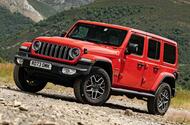
We put its long-distance driving ability to the test on a trip to Spain
Our Steve Cropley has been busy with this Jeep Wrangler, but one thing that he hasn’t managed to do is take the big Tonka toy on an overseas excursion.
This isn’t to call into question his appetite for discomfort: he once slogged across the Australian outback to interview for a job he had been assured he wasn’t going to get (he got it). But it’s a fact that anything with a ladder-frame construction isn’t exactly going to rock your passengers to sleep.
Steve’s descriptions of the Wrangler’s ride quality mostly extend to a laconic ‘rough’, while conceding that after a bit you do stop noticing it – something I now agree with wholeheartedly.
I’m freshly in a position to pass judgement, having just come back from Spain. My wife and I took the ferry out to Santander then drove up through France. There are better cars on our fleet in which to cover 2000 miles and certainly more economical ones, but trust me: none are as fun-loving or reassuring for five days gallivanting through the remoter parts of Asturias and León, looking out for – among other exciting beasts – those frustratingly clandestine Iberian wolves.
As for the business of motorway toiling, the Wrangler really wasn’t at all bad. With that slabby frontal area, anything above 75mph feels like re-entry, but keep it steady and it rolls along easily enough, and resists hunting and drifting off line as the Ineos Grenadier likes to do.
Excellent chunky seats, too. Poor hi-fi, though. With 20,000 miles on the clock, the digital display threw up an oil-change warning two days before we left. That meant £100 spent at a little independent garage round the corner and a big stretch over the car’s ridiculous prognathic bumper for poor Tasos the mechanic, but inspection of the old oil revealed that it was well worth doing. Other than that, the car was perfectly reliable.
Foibles include the total lack of a footrest in the narrow pedal box; the fact that the metal-effect dip on the driver’s side door handle is already peeling off; the lack of a boot cover (particularly annoying when you’re carting all your clobber from place to place); and, of course, the fact that you have to swing open the wide tailgate before you can fold up the upper glass panel, which makes parking in the medieval parts of various European cities a challenge.
In tight corners you also need to be mindful of snagging the chunky rear arches. Oddment storage could be better, too: there are cupholders but no trays for keys and the like, other than the one directly beneath the armrest cover, so we kept losing bits and bobs.
Positives? This generation of Wrangler steers with actual accuracy, so it doesn’t drain you attritionally during a day in the saddle. It is remarkably car-like for something with a low-range gearing. The lack of over-sensitive ADAS is refreshing.
Climbing up into the Wrangler’s chunky cabin, with its great visibility through the pillbox windscreen, never fails to give you a little dopamine hit. Its Android Auto works nicely. The 2.0-litre four-cylinder petrol engine is far more effective and characterful than I expected, hauling two tonnes of Ohio-built bulk about in pretty effortless fashion.
The gearbox is fine, too: you don’t have to think about it. Less tangibly, the thing has a sense of occasion – something, say, a BMW X5 will never match. Equally, the economy wasn’t terrible (for the entire trip, the brim-to-brim figure was 30.3mpg), and the 81-litre fuel tank means you can make plenty of uninterrupted progress when needed.
As for proper off-roading in Spain, in the end the Wrangler played a supporting role. You need a permit to access the really horrible tracks that take you up into the wildest valleys in León, so this task was undertaken by our guide’s fabulously trusty and surprisingly comfy Land Cruiser (white with a manual ’box, cloth seats and steelies – the bee’s knees, basically).
However, there was no question that our Jeep could have scrambled anywhere the Toyota went, had we needed it to. I’ve experienced the colossal toughness and capability that lurks behind the cartoonish looks first hand, having spent three days in the JL-generation car on the axle-breaking Rubicon Trail in 2018 – still perhaps the most memorable and brilliant thing I’ve done in this job.
Unlike the Land Cruiser, the Wrangler’s driveline can also be put into pure rear-wheel-drive mode for better everyday economy and oversteer on damp switchbacks.
So the Wrangler returns from this 2200-mile jaunt with its Swiss Army knife credentials, if anything, enhanced. Honestly, I was surprised how easy it made the mile-bashing, and even a 10-hour blast home from La Rochelle wasn’t knackering (even if the car’s adaptive cruise control simply will not let you sweep around slower motorway traffic smoothly).
I know that, for a price, a Defender would have made life easier still, and we saw quite a few in the Basque Country and around Bordeaux. But, tellingly, seeing the Land Rovers go by through the fly-spattered windscreen of our plodding Wrangler, I wasn’t at all envious.