Ultra-exclusive Lambo Temerario twin gets nearly 1000bhp from hybrid V8 – and introduces new design language
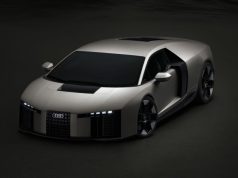
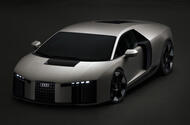
The new Audi Nuvolari is a limited-run 987bhp V8 hybrid supercar that serves as a new flagship more exclusive than the R8 – and, according to boss Gernot Döllner, serves as “a statement for the future” of the brand.
Powered by a twin-turbocharged 4.0-litre engine aided by three electric motors, the mid-engined Nuvolari is the fastest and most powerful production car the German firm has ever produced.
It features Formula 1-inspired technology including active aerodynamics, a carbonfibre body and a torque vectoring four-wheel drive system.
Due to arrive early next year and limited to 499 units, the Nuvolari is the first car that will go into production showcasing Audi’s new design language, first previewed by last year’s Concept C.
Revealed in near-production form, Audi claims that the Nuvolari is the “next tangible evidence” of its renewal after the Concept C.
Döllner added that the supercar “brings together outstanding design and a new speed of innovation with a lot of technical content”.
Serving as the flagship of Audi’s new-era line-up, the Nuvolari is pitched above the R8 that it effectively succeeds in terms of both pricing and ethos.
Similarly to how the two generations of its predecessor (which went out of production in 2024) shared their technical underpinnings with the Lamborghini Gallardo and Hurácan, the Nuvolari shares its powertrain technology with the fellow Volkswagen Group brand’s new Temarario.
Rather than reviving the R8 title, it moves away from Audi’s traditional alphanumeric badging convention and takes it name from Tazio Nuvolari, one of the most successful pre-war grand prix racers, who latterly drove for Audi predecessor Auto Union.
Powertrain and performance
The Nuvolari was developed in around 14 months after being given the green light in March 2025, with that timeline set so that it could be launched in Audi’s first season competing in F1.
Audi’s new technical boss, Rouven Mohr (who joined the brand from Lamborghini, where he oversaw development of the Temarario), said that “our entire team has once again demonstrated its technical expertise, innovative strength and dedication” in making the car.
Mohr told Autocar that the Nuvolari was developed by a “cross-brand team” involving engineers from Audi, its F1 team and Lamborghini.
Mohr added: “The Concept C was the visualisation of the new design language, but ‘Radical Next’ can be more than design, it can be product and technology.”
The powertrain is based around the same 4.0-litre V8 used in the Temarario, which on its own offers 789bhp and 538lb ft of torque and can rev up to 10,000rpm.
That is supplemented by three axial flux electric motors, each of which produces 148bhp.
Two of the motors are oil-cooled and mounted on the front axle, delivering up to 1586lb ft. The third motor is mounted between the mid-mounted V8 and the transmission. The motors draw power from a 7.3kWh battery, compared with a 3.8kWh unit in the Temarario.
Total system output is 987bhp, which is notably 80bhp more than the Temerario, despite the individual maximum output of the engine and motors being the same. The increase is due to a bespoke torque map and software and the larger battery.
It’s enough to power the Nuvolari from 0-62mph in 2.6sec – 0.1sec quicker than the Temarario – and onto 124mph in 6.8sec. Its top speed is more than 217mph.
Mohr said: “The character of the two cars is completely different. If you would drive the car, you would not know that there is a similarity of the powertrain, you would never come on the idea, because this car really drives more from the Audi perspective. It gives you a very direct feeling on being relaxed and fast, but you can be fast like hell. An Audi always has to be stuck on the performance daily-user capability and a very high precision.”
The hybrid powertrain features an advanced torque-vectoring system that is branded as Quattro Predictive Ride. Audi refers to it as the “next generation of all-wheel-drive”.
It essentially takes data from various sensors, measuring steering angle, acceleration, yaw rate and grip to distribute torque to the wheels as needed. It does this by controlling the front motors and can also utilise the brakes as needed and adjust the active aerodynamics to reduce slip.
There are various drive modes, selected via a steering wheel-mounted dial: E-Hybrid, Balanced, Dynamic, Dynamic+ and Track.
The Nuvolari’s energy management system can adapt to driving conditions, grip levels and “driver intent”, blending coasting and brake recuperation to optimise energy recovery.
The front motors are responsible for a significant portion of the braking energy on the front axle, and in total up to 0.3g of deceleration can be generated by the electric system alone.
The launch control function also makes used of the stored electric energy to offer maximum acceleration.
The Nuvolari sits on 21in wheels, with Bridgestone Potenza race tyres measuring 255/35 at the front and 325/30 at the rear.
The brake-by-wire system with carbon-ceramic discs has been designed to blend with the energy recovery functions. There are ten-piston fixed callipers with 420x40mm discs on the front axle and four-piston 410x32mm discs on the rear.
Audi claims the cooling system increases heat dissipation by up to 21% compared with normal carbon-ceramic systems and claims the system can handle deceleration loads on par with an F1 car.
Chassis and aerodynamics
The Nuvolari is built around a spaceframe body and is the first production Audi to feature a carbonfibre exterior, with most components made from carbonfibre reinforced polymer (CFRP), similar to an F1 car.
The various parts are pre-shaped and then cured at high pressure and temperature, a process that is claimed to maximise structural performance while minimising weight.
Certain parts of the car that are exposed to high temperatures use heat-resistant materials.
The exterior bodywork has been honed for aerodynamic performance and includes a front splitter and dramatic rear diffuser.
Audi F1 drivers Gabriel Bortoleto and Nico Hülkenberg are said to have produced feedback to fine-tune the aerodynamic development.
Also derived from F1 are the Nuvolari’s active aerodynamics, which can balance downforce, drag and aerodynamic balance. The active rear wing has three settings: Closed, Low Downforce (LD) and High Downforce (HD).
There are large front air intakes to aid the cooling of the brakes and boost thermal management of the motors, plus an S-duct (technology previously seen in F1) that adds downforce at high speeds and provides extra cooling for the powertrain.
In Dynamic, Dynamic+ and Track modes, the rear wing operates automatically and will shift to the LD position on straights to boost top speed. There’s a manually selectable drag reduction system (DRS) that further lowers the wing. Under braking, the wing will then automatically adjust to HD position; in this mode, the Nuvolari can generate more than 400kg of downforce.
Audi wouldn’t be drawn on the weight of the Nuvolari but, with its carbonfibre body and aluminium frame, it’s expected to tip the scales lighter than the 1690kg (dry) Temerario.
Design
Thanks to its short 14-month development time, the Nuvolari will be the first production Audi to feature the new design language being introduced by new styling chief Massimo Frascella.
It therefore gives strong clues as to what to expect from the next generation of the firm’s more mainstream models.
The exterior is largely shaped by the aerodynamics, with an interpretation of the reduced, vertically oriented ‘Singleframe’ grille previewed by the Concept C – which will be a feature of the next-generation of Audi models.
The square grille on the Nuvolari is reminiscent of the one featured on the Concept C but features a number of small square elements, which are angled to optimise aerodynamics.
The version of the Nuvolari shown at the launch event was finished in Titanium, Audi’s new signature colour, as already seen on its F1 cars and the Concept C.
Notably, at the rear of the car the Audi rings found on the top of the adjustable rear wing are milled from aluminium and then set flush inside the carbonfibre bodywork.
The interior also showcases the brand’s renewed focus on simplicity, with what it claims is a “driver-centric approach”. The key functions are all placed within the driver’s field of vision.
The colour accents used for various controls are inspired by the Auto Union Type C racer campaigned by Nuvolari in the late 1930s.
The cabin also uses colour to split the cabin into two zones. The front section is finished in darker tones, claimed to aid concentration, while the rear of the interior is finished in a lighter tone called Shadow Dune.
Pricing details for the Nuvolari haven’t been made public, but the Temarario starts from £259,000. Deliveries of the 499 examples are due to begin in the first half of next year.