
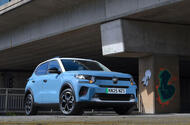
Giles Vidal wants his brands to “compete more against the real competition and less between ourselves”
Stellantis is working to more clearly differentiate its brands under new European design chief Gilles Vidal so they “compete more against the real competition” rather than between themselves.
The Frenchman returned to the conglomerate in 2025 after a five-year stint with rival Renault, having overseen the production designs of the highly lauded 4, 5 and the new Twingo.
He previously made his name as the chief designer of Peugeot during the 2010s, where he introduced a new design language and was involved in the introduction of the i-Cockpit.
Now, as the dust settles on his first months back at Stellantis, he told Autocar that his aim was to “orchestrate enough differentiation between the different brands so that those brands matter”.
He continued: “The client will still compare an Opel/Vauxhall to a Peugeot to a Citroën and maybe hesitate between two Stellantis products, because Stellantis isn’t a thing for most clients.
“We can control and strategise all of this. We will make sure that we compete more against the real competition and less between ourselves, so the branding is super-important.
Vidal highlighted the previous-generation Citroën C5 Aircross, Peugeot 3008, Peugeot 5008 and Vauxhall Grandland as “an era where we did this [distinction] very well”. They were “very, very different cars not just in terms of design but in terms of driving”, he explained, yet “they were one single programme within [Stellantis precursor] PSA”.
Acknowledging that multiple models across Stellantis’s European brands – Abarth, Alfa Romeo, Citroën, DS, Fiat, Jeep, Lancia, Maserati, Opel/Vauxhall and Peugeot – share platforms and therefore key structural hardpoints, he said his ambition is to deliver cars that more clearly look and feel distinct from one another, “not clones”.
“The general public doesn’t care so much about Stellantis: they care about the brands themselves,” he said. “You buy a Peugeot, an Opel or Vauxhall, a Fiat or whatever; you don’t buy a Stellantis car. So we need to be super-sharp about what our brands stand for.
“And the brands are the biggest asset of the company from the public perspective, even if we want to optimise Stellantis as a company and about what it does.”
Vidal said Peugeot will go big on “innovation”, exemplified by the recent Polygon concept and its Hypersquare steer-by-wire system. “Maybe we could push it even further,” he continued, “as powerful and strong ideas like that could be very interesting.” Its exterior designs, however, will remain broadly in line with those of today: “The result as a finished product can stay an elegant piece of design and not just a futuristic, crazy design.”
Citroën “is a completely different story,” Vidal said, explaining that it will push hard to become an “affordable brand” but without neglecting its historical “weirdness”. Characteristics such as modularity and spacious, airy cabins will become crucial as the brand looks to deliver on “experience”, with “inventive” solutions such as the ELO concept, a micro-MPV.
DS will continue with “French premium”, he said, while Fiat will carry on the path set by the Grande Panda with a “family” of models. Vidal wants to make Opel the “most creative German brand”, with its UK-market twin Vauxhall sporting “super-German designs”.
Alfa Romeo meanwhile will major in producing driver’s cars, with physical switchgear and tactility key to fostering a sense of connection to the machine. “The 33 Stradale [supercar] is a crazy example, obviously a bit expensive, but the point is that’s what you want to experience in the affordable Alfa Romeos,” said Vidal. “That’s the kind of feel you want when you’re in a Junior.”
Of all the brands in Stellantis’s European portfolio, Vidal highlighted Maserati as the one most evidently due reinvention. He said: “If you look at the history of Maserati, every two decades or so there was a big shift in design. You had very curvy Maseratis in the ’50s and ’60s, it switched completely to edgy design in the ’70s and ’80s, then beasts in the late ’80s and ’90s, then back to curvy but in a different way. Every chunk of 20 years, you can observe more or less a complete shift in design language. So what we are looking at is the next thing. The loop is now theoretically finished, so what is the next thing?”