Lower-riding sibling to EV2 could take ‘EV1’ badge and be an electric Picanto replacement
Two crucial new volume models inbound as Kia aims to ramp up EV sales in challenging market
Kia will launch a new small electric hatchback in Europe next year as part of a strategy to dramatically boost its EV sales mix in the region by the end of the decade.
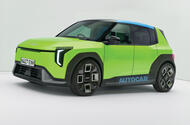
The new model, which is described as a ‘B-hatch’, is expected to be a similarly sized but lower-riding sibling to the upright Kia EV2, and serve as a rival to the likes of the Renault 5, Peugeot e-208 and Vauxhall Corsa Electric.
Kia says the new Europe-focused model – which could be positioned as an EV alternative to the Picanto and take the EV1 badge – will be the first ‘software-defined vehicle’ in this segment, referring to its strategy of centrally integrating all of the car’s core systems into one unit.
It will use the same 400-volt E-GMP platform as the EV2, and is expected to share the taller car’s 42.2kWh and 61kWh batteries, for a range window that’s likely to span from 200 miles in the cheapest variants, up towards 300 in the Long Range car.
Kia has given no concrete details of the hatchback, but it will be the firm’s cheapest electric car, with prices likely to start in the low-£20,000s to line it up against its Renault and Stellantis rivals.
There’s no word, either, on where it could be built, but the company’s push to build cars in the regions where they are sold means the EV2 factory in Slovakia is a likely candidate.
The ‘EV1’ will be one of 14 electric vehicles Kia plans to offer across all segments globally by 2030, up from 11 today – with that total made up of two ‘passenger models’, nine SUVs and three ‘purpose-built vehicles’ (commercial vehicles).
One of the new SUV models will be a ‘flagship volume EV model’ launching in 2029, which Kia says will build “on its SUV heritage to drive trade-up demand from Sportage HEV and PHEV, as well as high-trim EV5 customers.”
The new additions form part of a strategy to grow EV sales to one million units per year by 2030, for a market share of 3.8%, up from 250,000 and 1.7% in 2025. That goal is down around 20% on Kia’s earlier plans, in recognition that EV uptake is progressing at different speeds in different global regions, and combustion-based drivetrains still have a significant role to play in the coming years.
Speaking at Kia’s annual investor day conference in Seoul earlier today (9 April), Kia CEO Ho Sung Song said the global electric vehicle market “is now entering the ‘chasm’ phase”, with growth slowing following an initial spike in demand during the early phases of the EV roll-out.
“To date, the EV market has been driven mainly by early adopters of new technology,” he said. “However, as growth has slowed relative to initial expectations, global EV penetration reached approximately 16% last year.”
Song said that to overcome this ‘chasm’ and drive EV uptake, “the focus must be on improving affordability and expanding charging infrastructure in ways that deliver tangible value to a wider customer base.”
Affordable models like the EV1 and high-volume mainstream contenders including the electric SUV in 2029 will play a significant role in this context, but Kia said it is also crucial that it “strengthens EV competitiveness by improving the overall product quality of our EV offerings”.
To that end, the company will introduce a new platform in the coming years to replace the ‘E-GMP’ architecture that underpins all of its current EVs.
This new structure is said to bring a 40% increase in battery capacities, offer an 9% boost in motor output and be capable of offering ‘level two plus-plus’ self-driving functionality, whereby the vehicle can effectively drive itself with no human input – though the driver must remain focused at all times.
The new platform will also accommodate what Kia calls ‘fifth-generation’ batteries – with 15% greater energy density and 30% cheaper chemistry – and contain an advanced new software structure that underpins a new infotainment system.
It has not yet confirmed which models will be the first to use the new platform, but the Sportage-sized SUV coming towards the end of the decade is a likely candidate.
While Kia invests in expanding and developing its EV line-up over the coming years, however, it remains committed to its global combustion powertrain offering and will “continue to expand our ICE and hybrid line-ups strategically, aligning with the pace of electrification in each market.”
That is particularly relevant in the US and certain emerging markets, where EV uptake remains heavily constrained, but Kia still plans for electric vehicles to account for two thirds of all of its sales in Europe by the end of the decade.
Song said that while “demand in Western European market is expected to remain constrained through 2030”, largely because of the easing of CO2 regulations in the region, EVs are still forecasted to account for 43% of the local market by 2030, and Kia plans to far outpace that market average with a 66% EV sales mix – “underscoring our commitment to lead the European EV market”.