
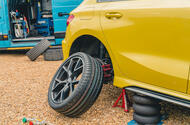
We take a deep dive into the complex engineering of modern tyres and how it affects your comfort
You can’t discuss a car’s ride quality without also talking about tyres. As the only point of contact between the vehicle and the road surface, the rubber wrapped around the wheels are going to play a crucial role in how bumps and lumps are transmitted through to the cabin.
Of course, there are many other factors to consider, such as suspension components and geometry, even the stiffness of the car’s chassis, but here we’re going to take a closer look at tyres.
To most people, tyres are all pretty much the same, which is round and black, but dig deeper and you will find that automotive engineers sweat buckets ensuring they make your car ride as well as they can.
That said, we don’t think you can talk about ride comfort without also considering refinement. It’s all well and good having a car that soaks away surface imperfection, but if the noise from your car’s tyres results in every two-hour journey giving you a four hour headache, then what’s the point of a cushioned ride?
So here we take a little look at tyres, ride comfort and the technology that goes into keeping your car on even keel when the Tarmac gets turbulent.
Ride comfort
Like many areas of automotive engineering, tyre technology is a complicated old business. How a certain type of rubber grips, relays feedback and, yes, rides is dependent on myriad factors. Everything from the construction of the metal carcass to the tread pattern will play its part in determining how smoothly your car deals with the bumps.
As we’ve already mentioned, there are myriad factors influencing ride quality, such as suspension set-up and the body’s structural stiffness. Adding tyres to the mix only makes things more complicated, because, due to the nature of their construction, they act as both a spring and a damper. Influencing this behaviour is the rubber compound, the stiffness of the metal carcass and the overall size of the tyre, just to name a few factors.
However, one of the clearest indicators of how a tyre might tackle bumps is to be found in its sidewall depth. Over the years, an emphasis on ‘sporty’ handling and sharp steering response has resulted in the increased use of low-profile rubber. The profile is the depth of the sidewall represented as a ratio of the tyre’s width, so a 225/40 18 example has a profile that’s 40% of that 225mm width.
Theoretically, the lower the profile, the more ‘immediate’ the car will feel on corner entry as the smaller, stiffer sidewall deforms less under lateral load for better precision and grip. Yet the downside of this is obviously less ‘give’ in the tyre under vertical load, leading to a less comfortable ride. This tends to be more clearly noticeable over sharper road imperfections, such as potholes.
Assuming the suspension has been tuned to work with various different tyres sizes, the same car fitted with, say, a 205/55 16 tyre instead of that 225/40 18 will feel smoother over the bumps, its squidgier sidewall helping absorb some of the sharper shocks.
Yet as ever with tyre technology, it’s more complicated than that. Take run-flat rubber for instance, which has been favoured by BMW over the past couple of decades. To allow the car to carry on driving even after a puncture, these tyres have very stiff sidewalls, which – you’ve guessed it – result in a rather discombobulated ride.
Then there’s the matter of unsprung mass. Essentially, this is any part of the car not supported by the suspension, so this means the wheels, brakes, axles and, yes, tyres. If you’ve got big, heavy wheels, the springs and dampers will have a hard time controlling their movement as they jump and skip over imperfections in the road.
There are also factors that are within your control, such as the tyre pressures. Set these higher than the manufacturer’s rating and the ride will likely deteriorate on the over-inflated rubber. Moreover, set the pressure too low and the sidewall will have to work harder, leading to an equally restless ride and leave it vulnerable to damage from potholes. The amount you carry in a car can have consequences too, with heavily laden vehicles sometimes feeling more restful than when it’s just the driver and nothing else on board.
Refinement
In many respects, ride and refinement go hand in hand. A car that deals with bumps and road surfaces quietly can often trick the driver’s mind into thinking it’s actually riding better than it is. Effectively a large chamber filled with air, an inflated tyre acts like a resonator as it amplifies road noise from the surface it rolls across. As a result, engineers have a number of solutions up their sleeves to make tyres roll with less rowdiness.
In fact, like grip and rolling resistance, noise levels are actually rated on modern tyres. Look at a new rubber and you will see a label that looks like a speaker with either an A, B or C next to it. This gives an indication of the noise the tyre emits at around 50mph (80kph), with A being the quietest and C the loudest.
The rise of EVs has accelerated quieter tyre technology, as the elimination of traditional internal combustion sounds has drawn attention to other areas of aural intrusion. One of the most obvious areas of noise generation is the tread itself, with the shape of the blocks and channels dictating what sort of frequencies are generated when the rubber is rolling.
More recently, tyre makers have started to create special polyurethane foam inserts that line the underside of the tyre tread, reducing unwanted road noise by up to 20% depending on the brand. On new cars, the amount of foam is often tailored specifically to the model, helping cut out certain harmonics particular to that vehicle.
An even more high-tech solution is active noise cancelling, which helps muffle more than just tyre roar. Much like the systems used in many modern headphones, this kit uses microphones dotted around the car to monitor noise and then the audio system’s speaker to essentially fire back a similar frequency sound to cancel out the disturbance.
Ultimately, tyres play a crucial role in how your car rides and how refined it is, but they are just one factor of many in a motor’s dynamic make-up. However, there are some clues you can spot increase the chance of your rubber delivering a more restful driving experience when it’s time to change tread. If serene progress is your priority, look for tyres with the lowest noise rating and, where possible, the highest sidewall profile.