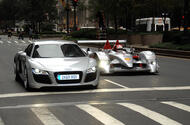
We revisit the “bonkers” era of Audi’s diesel-powered halo cars – and the one SUV that actually made it to the road
After several years of dominance at Le Mans, Audi made the surprise announcement in December 2005 that its next entry would be a diesel: the R10 TDI.
This prototype wasn’t the first diesel to contest the famous 24-hour race but did become the first to win it outright, in 2006 and repeated the trick in the following two years.
This was an excellent marketing tool for Audi in an era when EU law demanded lower CO₂ emissions from car makers and lower tax rates were applied to diesel cars than their petrol equivalents.
As a result, at the beginning of 2008, Audi went through an all-too-brief period of unveiling bonkers, diesel-powered halo models that were directly inspired by the company’s Le Mans exploits.
The first of these to appear was the R8 V12 TDI concept, unveiled in January 2008 as “the world’s first diesel supercar”. This was a controversial idea, sure, but people were soon won over by the details.
Being propelled by a new twin-turbocharged 5.9-litre V12, the TDI concept produced more power (493bhp) than the 4.2-litre V8 in the existing road-going R8 (414bhp) and twice as much torque, yet it was also said to be capable of 25mpg (6mpg up on the R8 V8).
And, for a dose of supercar drama, it retained the same open-gate, six-speed manual gearbox.
Best of all, unlike most concepts, the R8 V12 TDI was fully functional. We flew out to Miami in April 2008 to drive it, and our initial impressions were good.
With a monstrous 738lb ft of torque on tap (delivered at just 1750rpm!), it was very fast indeed and due to the powerplant having so many different filters to make it emissions-friendly, which stifled almost all exhaust noise, it was very refined too.
Enjoy full access to the complete Autocar archive at the magazineshop.com
Our tester concluded that “this car could turn out to be the best sports car for everyday use the world has ever known”, and Audi was confident that production was 18 months away.
The hot oil-burners didn’t stop there. Soon afterwards, a range-topping variant of the youthful Q7 SUV powered by the same 12-cylinder diesel engine, complete with an R10 TDI-derived injection system and crankshaft, got the green light for production.
This was then followed by a third car, the lesser-known A3 Clubsport concept.
Based on the second generation of Audi’s midsized hatchback, the Clubsport previewed a diesel-powered hot hatch that produced a respectable 221bhp and 332lb ft from a 2.0-litre diesel four, complete with crazy bodywork extensions and carbon-ceramic brakes and, on the inside, bucket seats and the R8’s gated manual.
Within a few short months, all three of these cars were unveiled by a company that was making its intentions crystal clear: diesel would be a major part of the future for its performance car range.
However, whether due to technical complications or low confidence about the public reception, the A3 Clubsport never made it out of the press photos. Instead, Audi gave us the five-cylinder petrol RS3 in 2010.
The R8 V12 TDI, despite the hype, likewise never materialised. Production was promised, but the range-topping R8 instead arrived with a petrol V10. And, of course, if any hopes were still remaining for a resurgence of diesel-powered Audi halo models before 2015, a certain Volkswagen scandal killed the idea for good.
In the years that followed, the occasional mildly quick diesel did sneak its way into Audi’s range the S4, SQ5 and SQ7 TDIs, to name a few. But none was ever as interesting as those halo models unveiled in 2008, and up until the present day Audi’s flagship performance cars have continued to favour petrol as their drink of choice.
This means that the only survivor from this crazy period was the Q7 V12 TDI, which was built in limited numbers between 2008 and 2012.
Examples are very rare today, partially due to an original list price of £96,295 (equivalent to £160,000 today) and partially due to the extraordinary costs to keep them going balanced against their horrendous initial depreciation.
However, if you can find one, it can be seen in hindsight as a piece of evidence from a short-lived period in Audi’s history when diesel power really was the future of performance.