Boss called EVs “an expensive hobby” but firm is still working on one – and emotional appeal remains central
Lamborghini is still working on an electric car for launch after 2030 – having recently decided to equip its fourth model, the Lanzdaor, with a PHEV powertrain instead of an all-electric one – and boss Stephan Winkelmann said a key priority is giving it the same appeal as its combustion cars.
Following his recent decision to delay Lamborghini’s EV plans, Winkelmann was widely quoted as saying electric car development was “an expensive hobby” for low-volume manufacturers. However, he has now clarified that the quote was “a bit taken out of context” and explained that the Italian firm has not completely ditched its electric car plans.
“I didn’t say it this way. I just want to underline this,” he said.
Rather than scrapping EV development entirely, he said, Lamborghini has shifted the targeted launch date for its first electric car past the end of the decade and is actively evaluating new ways of making it appealing to traditional Lamborghini customers, in the context of flatlining demand for electric luxury and sports cars.
“The new timeframe is, for sure, after 2030. We will follow very closely the rate of acceptance of electric cars in the future for our types of customers,” he told Autocar, adding that the firm remains rigidly committed to ensuring its EVs feel and sound markedly different from the competition.
He said: “We are continuing to work on all what matters to be ready to do an electric car, but here we are speaking about something which is emotional and not going to be explained in a rational way.
“We discovered that the rejection rate of full-electric cars is increasing, and this is something which is going to affect the sales of a full-electric car from Lamborghini.
“You don’t buy a Lamborghini because you want to move from A to B on a daily basis. You buy a Lamborghini because it’s something which is a childhood dream, or maybe because it’s the fulfilment of a life full of more work, and you want to have something which is exceeding your expectations.”
The cost of rewriting Lamborghini’s EV strategy was partially reflected in its financial performance last year. It delivered a record 10,747 cars worldwide for revenues of €3.2 billion (£2.8bn) but recorded an 8.3% drop in profits, chiefly as a result of tariffs in the US, but exchange rate fluctuations and the strategy overhaul were other key factors.
Winkelmann said the company will use the extended development timeframe to ensure its EV caters to those demands, and is closely analysing how competitors “make electric cars emotional”.
A crucial component of this emotional appeal, Winkelmann said, is the soundtrack – an element that has always been central to Lamborghini’s V8, V10 and V12 models but will be difficult to replicate in a car without an engine.
“One of the biggest topics of ‘rejection’ of full-electric cars is the missing sound. The sound of the engine is one of the major elements of why people buy these cars,” he said.
Winkelmann has previously spoken of the importance of sound in this context, but acknowledging artificial engine note soundtracks are becoming more common in performance-focused EVs – the Hyundai Ioniq 5 N, Abarth 600e and upcoming Mercedes-AMG GT, for example – he said Lamborghini is focused on creating its own authentic and distinctive solution.
“You can do a lot of things: you can also put a record player in the car and fake the combustion engine,” he said, but this is unlikely to be the route the Sant’Agata firm takes. “The point is if this is what you want in a car like a Lamborghini, where reality is what you want. You don’t want something which is not real. At least, that is my perception.”
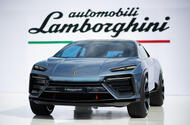
Irrespective of Lamborghini’s EV timeline, the company still plans to bring a production version of its Lanzador 2+2 concept to showrooms by the end of the decade – though now with a plug-in hybrid powertrain rather than a pure-electric one, as initially planned.
Winkelmann said the final car “will be a bit different in bodystyle” but will fundamentally remain a two-door 2+2. Precise details are under wraps, but the company’s fourth model line – sitting below the Urus – is now expected to be closely related to the Urus underneath and use a variant of the larger SUV’s 4.0-litre twin-turbocharged V8 PHEV powertrain.