Chinese firm is planning to build a European factory, but that will inevitably undermine its cost advantage
MG has built up a formidable market share in the UK and Europe thanks to its broad range of appealing models priced to undercut European competition.
That has been possible due to parent company SAIC’s manufacturing base in China, which works to a much lower cost than local rates.
Now the brand is getting closer to long-planned European production, but it has to work out how to persuade customers to pay more for local built models to offset the higher production cost.
“To build in Europe, you cannot sell on price because the manufacturing cost will be a lot higher,” William Wang, head of MG in Europe, told Autocar in a rare interview. “You need to sell on your brand and your value.”
Unlike BYD, MG has yet to finalise its European production location but it’s ongoing, with Wang regularly flying to locations within the European Union along with MG’s European production manager.
Wang says the UK is still an outside possibility for the brand’s first full-scale production facility in the region under SAIC ownership, but he also said that an EU location is most likely. If everything goes smoothly production could start as early as next year, Wang said.
Wang gave no indication which countries were on his shortlist of five, but southern European locations like Spain or those in eastern Europe including Hungary (location of BYD’s new plant) are most likely given lower costs and EU membership.
Being within the EU also means the end of punitive tariffs on Chinese built-EVs, which hit MG the hardest after SAIC was given the highest rate of 45% after refusing to comply with the EU’s investigation into the level of state subsidies it receives.
Production will focus on EVs, rather than the biggest selling ZS and HS hybrid/combustion-engine SUVs, Wang confirmed.
Building in Europe will help cement the idea MG is a British/European brand, rather than a Chinese one, Wang hopes. “Under my team, we’ve always treated MG as British,” he said.
This brand solidity versus new Chinese nameplates is one weapon in MG’s battle to persuade customers to pay a bit extra to cover the cost of European manufacturing. “The best backbone for our development is the brand,” he said. The other is that Chinese strength: the latest tech. “MG should represent constantly evolving, affordable technology,” he added.
Competing on both price and tech has proven a winning combination for Chinese carmakers, which hit a market share of 14% in January in the UK thanks to a broad mix of plug-in hybrid, hybrid and electric cars. But winning on electrified tech when you’re subject to similar production costs as your European rivals is harder. The competition is tougher.
Wang likens automotive competition to a vengeful bear out to attack the weakest. “You must make sure you run faster than the others, otherwise the bear will catch you first,” Wang said.
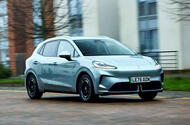
Without the price differential, the bear moves that bit closer. Wang didn’t say exactly which cars will be produced at the plant but one technology that MG is looking to deploy in Europe and could possible localise is the semi-solid state battery, used first in the new MG 4 Urban on MG’s latest electric platform, dubbed E3 in the company, and due for launch in Europe at the end of the year.
The manganese-based chemistry is co-developed by SAIC and QingTao Energy and uses a less volatile gel-like electrolyte, said to increase the safety and preserve range in cold temperatures. “The car can go to minus 10 minus 20 degrees, but the performance is still there,” Wang said.
MG has yet to decide where to source batteries from for its European cars, with a lot riding on the details of new ‘Made in Europe’ feature of the EU’s Industrial Accelerator Act. Local production with the right level of local parts sourcing could unlock incentives that MG is currently frozen out of, for example the UK’s electric car grant, the lack of which is forcing MG to offer discounts to match.
Other technology mentioned by Wang that MG could bring to the fore to lift its brand power included intelligent chassis advancements. “In the future more of our cars will use CDC (continuously damping control),” Wang said. “All those premium car technologies will go to normal cars.”
MG will have to tap into a new supply chain that’s likely to be considerably more expensive than the one back home in China, but plenty of Chinese suppliers are already in Europe, including SAIC-owned Yangfeng, which makes cockpits and bumpers among other parts.
The other advantage of building locally is that the car is tailored exactly for the European market. Europe is MG’s biggest market globally, even compared to China, and that is influencing the cars that SAIC develops. However there’s nothing quite like building locally.
“If we make the right model, the right mix, the right local content, we can put more value on local,” Wang said. “For example, if it’s local, I can act or react at least two months quicker.” Right now cars like the Urban appear in China first mainly because they don’t have a long boat trip and haven’t yet been calibrated for the European market at MG’s engineering centres in Longbridge and Frankfurt.
Not everything will be built locally of course, preserving the value-for-money element of Chinese production. “We want to be seen as a local but also source globally,” Wang said. “For example not all Nissans come from Sunderland. Some of them come from Japan. It’s a global world.”