
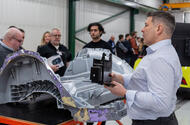
Many EVs have parts vulnerable to damage and nightmarish to repair; Thatcham Research aims to change that
“If we had a star design for the day, it would be this one,” said Darren Bright, principle engineer for automotive repair at Thatcham Research.
Bright is pointing at a naked charge-point socket with attendant high-voltage cabling stripped from an electric car. Next to it is another, very similar-looking socket from a rival car maker illustrating the sort of thing that Thatcham hates: a piece of design that’s nightmarish to repair and therefore much costlier to company’s backers, the UK car insurance industry.
Too much of the latter kind of design and not enough of the former has created a gap between the insurance costs of ICE cars EVs that Thatcham and the insurance industry would very much like to bring down. As of 2023, it stood at 25% for cars up to two years old.
This increases the likelihood that insurers will declare even lightly damaged EVs a total loss and therefore hike the vehicle risk rating (VRR), which has replaced the old insurance groups.
Thatcham has now channelled its frustration into creating what it calls the New Electric Vehicle Blueprint, which lists eight critical features for EVs that the car industry must incorporate into new designs to ensure a decent risk rating.
Car makers developing new EVs are working hard on new manufacturing and design innovations that help lower the cost of the car, for example cell-to-body structural batteries and ‘megacast’ single underbody pieces that replace dozens of welded metal parts.
Safety is also right at the forefront, along with security, thanks to the work of Thatcham and others.
What happens after you accidently drive over a neighbour’s rockery or suffer a tap on the back in a car park, however, is less well thought out. “Repairability is a bit lower on the manufacturers’ radar,” Bright said.
This is illustrated by the two charge ports arranged on a desk at Thatcham’s base on the outskirts of Newbury, Berkshire. The location and design of these is one of eight essential recommendations on the blueprint.
Damage the “star design” (by Tesla) and the port can be disconnected from the high-voltage cabling and replaced quickly. Damage the other (not named, but a telltale propeller symbol on it points to BMW) and the whole thing has to be replaced, requiring the battery to be dropped. Suddenly the parts and labour cost has rocketed and the car is more like to be written off rather than repaired.
Chargers in vulnerable locations such as the front or rear of the car are another Thatcham pet hate, putting them in danger of damage in the first place (black mark here for the Kia EV6, Dacia Spring and plenty of older EVs such as the Nissan Leaf and Kia Soul).
The battery itself is another worry – but not so much from the safety point of view, because car makers have worked hard to protect them. Instead the fear is that cars are judged unrepairable simply as a result of low-speed crashes that dent the edge of the casing.
That might require a new battery box or even an entirely new battery simply because you took a kerb wrong. Thatcham instead is calling for sacrificial metal that can be welded back after a crash.
“The battery is on average 40% of the value of the new car without any depreciation,” said Bright. “When you start talking one- or two-year-old vehicles, you’re into a whole different scenario and the repair options are not there. What we want to see is battery protection that’s actually removable.”
Other examples include low-voltage ‘safety loops’ that emergency services can snip to protect themselves from electrocution after an accident instead of cutting through the wiring loom. “We don’t want to be descriptive, but what we’d like is something cheap and easily repairable within minutes,” said Bright.
Much of this is just because the EV industry is new. ICE technology has been through all this to get to a decent level of repairability. For example, all ICE cars have long had a resettable fuel cut-off switch – equivalent to the safety loop for EVs – that activates in a crash to stop fuel from continuing to pump if the ignition hasn’t been turned off.
The equivalent in the ICE age to the pain of charging point repairability pain, meanwhile, was the switch from a one-piece fuel tank with a built-in neck to a two-piece system where you didn’t need to replace the whole tank in the event of a minor hit involving the filler. “I haven’t seen a one-piece tank in a long time,” said Dan Harrowell, principal engineer for advanced technologies at Thatcham.
EVs are getting better as manufacturers receive the message. Repair costs for EVs have decreased by 10.7% in the last three years, according to data from Gecko Risk, which tracks repair costs for EVs. “We need to keep that trend going as we scale,” said Harrowell.
For example, Thatcham showed a picture of the side sill of the new BMW iX3 next to a stripped-out version of the old one. The new car has what to Thatcham looks like a sacrificial metal protective strip that could potentially be welded back in a light accident, potentially avoiding writing off a £60,000-plus vehicle. They’ve got a car on order to find out for sure.
But the speed of development of EVs means there are new dangers for Britain’s network of repair centres. The rise of single-piece megacasting, beloved of Tesla and Chinese makers like Xpeng, requires detailed knowledge of which bits are structural and which can be cut away and repaired.
Structural batteries cause another headache. These are batteries that take the place of the flooring, providing rigidity to the point in that in the most extreme examples (Teslas for the North American market), when you drop the pack all you see is air. This means that the EV might have to stay on the service ramp while the repair is carried out or risk twisting the body beyond fixing. That in turn keeps ramps occupied, sending the repair bill shooting up.
These are categorised level-three or level-four structural batteries by Thatcham. “We’re trying to develop a kind of common language, so when somebody talks about a level-two battery, everyone knows what it is,” said Harrowell.
There’s no real pattern as to who are the main culprits, but Teslas and Chinese EVs tend to be more standardised and therefore easier to repair, because the manufacturers started from scratch rather than adapting ICE car platforms and now have more experience.
Chinese manufacturers have been penalised for Thatcham and the insurance industry on groupings for issues like parts supply, but they also come in for praise for being incredibly reactive. “Sometimes if you say there’s a problem, by the end of the day you see over a CAE [digital] model or somebody has brought prototype up to you to say ‘is this okay?’,” said Harrowell. “We’ve been very impressed.”
Adaptations can appear in cars within six to 12 months and digital adaptations even faster. “We’ve seen software changes within a week,” said Harrowell.
Thatcham now has to lean on its network of professional organisations globally to get the message across that car makers need to think about EV repairability at the design stage, with the tangible reward of better risk ratings and lower cost of ownership.
The battle Thatcham has is with the engineering and manufacturing departments racing at breakneck pace to cut the cost to develop and build the car while introducing new technology. The insurers would love them to add repairability to the list.
“We don’t want to stifle some of that technology, but it is also hurting us,” said Bright. “When it’s thought through, it doesn’t have to be more expensive.”