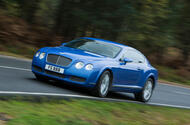
This landmark Bentley that launched the marque’s VW era can now be had for a tenth of the original price
The first product of a newly German-owned Bentley needed to be the best in years and it needed to be authentic to the brand.
Thankfully, it was both. Having acquired Bentley in 1998, the Volkswagen Group set about reinventing the storied but staid British brand as a thoroughly modern and highly profitable luxury marque to rival Rolls-Royce and Maybach.
Bentley now had easy access to up-to-date chassis and powertrain technology and could profit from huge economies of scale.
Traditionalists may have baulked, but that was a big factor in making the Continental GT (2003-2011) the most affordable Bentley in a long time – its £110,000 price made possible by shared architecture with the Audi A8 and VW Phaeton.
But was it a real Bentley? The figures from our 2003 test suggest so: 13.9mpg (for a real-world range of around 275 miles), a 2385kg kerb weight and a 6.0-litre twin-turbocharged W12 pumping out 552bhp and 479lb ft.
Big, boisterous numbers to back the flying B, and stats that seem especially towering in light of the piffling £9000 you can pay for a Conti these days.
Many thought the exterior brash at launch, but nowadays it appears right-sized and restrained. At 4.8m it’s barely longer than an Audi A5, and at under 2.0m wide it fits easily into the average parking spot.
The interior is Bentley-esque, though, and holds up brilliantly today. The leather upholstery (from 10 cows) still looks impressive, although this is not a large cabin, especially for those in the back.
Everything you touch feels appropriately expensive, and if you find one with more metal than wood, it won’t feel too out of date, ignoring the ancient infotainment.
Many will have been swapped for a more modern system, though. Just check it’s well integrated.
A used Conti holds up well as a daily driver too. It’s powerful, the boot is large and the roadholding is excellent thanks to standard four-wheel drive and adjustable air suspension.
It rides well, has surprisingly communicative steering and grips for longer than ought to be possible at this weight, although refinement isn’t up to par against alternatives like a Mercedes CL or Range Rover.
Otherwise, even the six-speed ZF automatic doesn’t feel antiquated, being sufficiently geared to allow a 196mph top speed.
In 2006, a convertible GTC joined the range and we felt it was the best and most authentic Conti we’d driven to date. Yes, the 2546kg kerb weight is frightful, but it is brilliantly insulated, keeping the cabin calm even at 175mph.
In 2007, Bentley facelifted the range, lightly altering the styling and interior and improving the ride. A new Mulliner Driving Specification option included drilled alloy sport pedals, a knurled chrome gearlever and diamond-quilted leather for the seat facings and doors.
The 600bhp, 553lb ft Speed was also introduced, which combined with suspension changes made the GT properly enjoyable so long as it wasn’t pushed too far.
For even more performance, the Supersports arrived in 2009 with 621bhp and 590lb ft and the capability of running on E85 biofuel. It shed 110kg (including the rear seats) and a genuinely exciting Bentley was created.
Don’t buy a cheap Conti without being prepared to spend what you paid for it all over again, but you’ll still have one of the best bargains on the road, looking and feeling a million dollars.
What to look for
Water ingress: The most notorious and costly fault involves water ingress in the front left-side footwell, which houses large sections of the wiring loom and ECUs. Any evidence of damp, a musty smell, or flickering electronics could mean a massive, £15,000-plus wiring loom repair.
Air suspension: The multi-mode air suspension is complex and prone to failure, usually due to leaking air struts or a failing compressor. Listen for knocking noises (worn bushes/drop links) and check if any corner of the car sits lower after being parked overnight. Replacements are very costly.
Cooling system: The W12 is densely packed and generates huge heat. Common failures include the water pump, coolant leaks from brittle vacuum hoses and radiator corrosion. Due to the engine’s packaging, accessing these parts is hugely labour-intensive, exponentially inflating the repair bill.
Battery: The GT uses two batteries and is notorious for draining them if left standing. Flat batteries can cause electrical systems and modules to throw error codes. Ensure both batteries are healthy and budget for a trickle charger if the car is not a daily driver.
Brake wear: The brake discs are immense 405mm steel units as standard. Budget £1000 for replacements all round, or £10,000 for the carbon-ceramic ones.
Electrics: Check that all complex electronics – the electric seat motors, the infotainment (prone to freezing) and the GTC soft-top mechanism (where applicable) – are fully functional. Replacing a failed convertible roof hydraulic system or motor will result in a five-figure bill.
Also worth knowing
There’s a third Continental in the family: the Flying Spur. It’s pretty much a GT stretched by 300mm with added doors and a traditional saloon-shaped boot. At the time, we regarded the muted W12 as a perfect fit for a limo and the acres of rear leg room appealed. But because of the slightly gawky styling, they’re now the cheapest of the Contis.
An owner’s view
Ben Richards: “I’ve owned my ’06 GT for four years and have clocked up 25,000 miles, pushing it to 75,000. I bought it knowing the running costs would be astronomical and they are. My yearly maintenance, even at an independent specialist, is about £4000. But the feeling of the W12 pulling on the motorway is intoxicating. Nothing else feels so solid, so rapid, and so effortlessly luxurious. I’d do it again.”
How much to spend
£9000-£14,999 Early, generally high-mileage cars or those with a poor service history. The biggest risk of major failures but also the biggest depreciation already absorbed.
£15,000-£24,999 This could be the sweet spot. Lots of low-mileage and well-cared-for cars, including facelifted ones. Look for desirable options like the Mulliner Driving Specification.
£25,000-£34,999 Late pre-facelifted cars and plenty of Speeds. Spending more than the lower end of this budget could net you the improved second-generation GT instead.
£35,000-£60,000 Mostly very clean Speeds and Supersports, but it’s doubtful that these will ever turn into proper collectors cars because of the numbers they were built in.