Manuals may have dwindled in number as auto ‘boxes take control, but stick-shifters are far from old news
Reports of the manual gearbox’s death are greatly exaggerated. Or at least they appear to be.
While Mini no longer sells a manual and the retirement of attainable heroes such as the Ford Fiesta and Focus has eroded some of the affordable driving fun from our showrooms, there’s still plenty of joy to be found if you look hard enough.
A vaguely scientific sweep of the configurators identifies 66 mainstream models still sold on British shores with a manual transmission as standard.
We’re not talking unobtanium GMA T50s and stratospheric Singer restomods, nor even the Porsche 911 or BMW M2. This is all sub-£40k, honest-to-goodness stuff.
Eight out of the UK’s 10 best-sellers of 2025 offer DIY gearshifting. Hyundai and Volkswagen appear to be the unlikely champions of the art, offering seven models apiece with a stick and three pedals at their entry point.
How much you truly desire a Bayon or Taigo shall, for today, be pushed to the peripheries, but the mere fact that you can row along a sensible little crossover yourself feels like good news enough, not least if it’s your randomly allocated prize in the holiday hire car lottery.
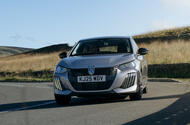
With a spot of luck, however, you might get the car pictured here.
Cheap, light, effervescent cars have been a speciality of the French for decades – just witness the reborn Renault 5 tearing up EV preconceptions for proof that the Gallic knack continues.
And for all the GTi, VTS and RS hall-of-famers, there are dozens of dowdier hatchbacks that offer a healthy fraction of the fun with much lower running costs.
The Peugeot 208 Style is as cheap as a brand-new Peugeot currently gets, starting at £20,495 with a 1.2-litre three-cylinder turbo engine driving its front wheels – through, you guessed it, a six-speed manual gearbox.
Power is a nice round 100bhp, while torque is a slightly more alluring 151lb ft (nearly as much as Renault’s all-time-great Clio 200 Cup).
Together, that’s enough to whisk the 208’s 1090kg from 0-62mph in 10.1sec. These are not the figures of a memorable pub boast, but as an antidote to the increasing complexity of the cars perched above the 208, they’re enough.
Agueda Yellow is Peugeot’s standard colour and the one you should pick to truly indulge the neon amusement arcade schtick we’re chasing here, but perhaps Cumulus Grey better conceals the delight within – the plastic egg wrapped around our vibrant new toy.
The wheels are already playing a sneaky game of their own, dinky 16in steelies hiding behind alloy-like trims that ape the bold designs of Peugeot’s posher, pricier offerings. Only the geekiest of passers-by might ever know.
There are sops to modernism. The key is a chunky plastic blob that you plonk in a cupholder (or tuck into your pocket) before depressing the clutch and holding the starter button for at least a second more than you would like.
Its engine then thrums perkily into life, unmistakably a triple right from the off, while the red, illuminated needles of its analogue dials spark up in the process.
Yup, the digital i-Cockpit is gatekept for higher trim levels, and I couldn’t be happier. I ran my own, first-gen 208 a few years ago (the racier GTi by Peugeot Sport) and always had a soft spot for its counterclockwise rev counter.
Whether it’s an unabashed nod to noughties Aston Martins or not, it’s fun. And we could all do with a healthy dose of that.
The dinky steering wheel of modern-day Peugeots is present and correct, but hopefully it irks its critics less when it’s operating a light and flighty front end.
You might swear the 208 is even skinnier than its on-paper kerb weight suggests, too; while this is no firecracker of an engine, its lungs are large enough for those 0-62mph claims to at least feel pessimistic.
I don’t imagine the Style will unduly trouble a stopwatch, yet its sensation of speed at least should put a smile on most faces.
Indeed, the whole impression is of a car that’s unburdened. There’s still ADAS to deactivate before you set off, if you’re so inclined, but this 208 otherwise operates with a purity exemplified by its physical handbrake.
I can’t remember the last time I was presented with one of those in a brand-new car…
Ahead of that sits the element we have driven deep into the moors to celebrate. This isn’t an especially artful gearlever, and it’s a long way from the machined aluminium knob of a Honda Civic Type R.
Whether its designers were inspired by the quiff of Johnny Bravo I can’t be sure, but the unusual shape at least provides a neat lip to wrap your middle and ring finger around while still allowing its H-pattern etching to peek out from under your palm.
This leverage allows for positive, physical shifts, especially when you’re downshifting into fourth or, more likely, second to keep the little Pug nicely on the boil.
Whereas proper hot hatchbacks thrive in third gear, second is the more useful ratio here, especially into tight corners or clearer-sighted bends with an uphill exit.
What it simply doesn’t possess is the razor-sharp precision of the best manuals still out there. The 208’s cheap, rubbery pedals provide little encouragement to freshen up your heel-and-toe technique – they’re neither large enough in size nor sharp enough in their responses for that sort of thing, although such modest outputs coursing through the front tyres at least ensure a clumsy shift won’t have any detrimental effect on the handling balance.
You’ll work the ‘box quite hard if you’re aiming to hustle the 208 along, mind. While second gear gets oh so close to nudging 60mph, this powertrain undoubtedly prefers earlier shifts. Peak power is delivered at 5500rpm, and there’s little reason to keep the needle buzzing beyond it.
The potency of the 1.2 Puretech’s turbocharging, with peak torque arriving at 1750rpm, means you can short-shift for the sheer amusement of grappling the lever with no real loss in real-world performance.
Fully wring this car out for all its worth on a favourite road and you’ll rarely trouble your licence, nor have to brake too often: its squidgy sidewalls and languid damping soak up most of the commitment you can reasonably throw at it.
Just watch your braking zones when you do need to slow the Style down – its enthusiastic imitation of a feistier French hatchback doesn’t extend to the size or stopping power of its brake discs.
In truth, such commitment feels like utter mischief when the rest of the car is so resolutely grown-up. The engine is reasonably hushed at a calmer cruise, and it will nudge 60mpg over long distances with ease (and low-to mid-50s elsewhere).
The equipment list is healthy for an entry point – electric windows all round, air-con, a lavish touchscreen, heated mirrors – and your touchpoints are all tangibly plusher than its Citroën relations (some internal brand politics play in the pricier Peugeot’s favour).
The overall impression is of a Stellantis success story, in fact. As we watch the conglomerate apparently fumble the future of Maserati – and with vast Citroën recalls appearing to be a monthly occurrence – this car nails its brief while fielding just enough ancestral familiarity to stop flagrant 205 nostalgia from feeling too misplaced.
The point was cheekily celebrated via the Swiss dealer-special Peugeot 208 Rallye, which took a pre-facelift 208 and applied white paint, naked white steelies and the red, blue and yellow graphics of Peugeot Talbot Sport endeavours past.
Garages Hotz SA has since gifted the same makeover to the updated car and renamed it the 208 R, and it charges only a mite more than Peugeot UK does for the car you see here. It’s impossible not to crave one, despite its power-to-weight ratio paling beside the vibrant 106, 205 and 306 Rallyes it emulates.
But let’s embrace what we can still buy here, not least for the rather 1990s vibe of its suffix, which feels as aspirational as a Clio Biarritz or AX Elation.
Maybe Festivals of the Unexceptional long into the future will celebrate the 208 Style among their cohort, its 65 manually shifted contemporaries scattered on the surrounding lawns. The mainstream manual isn’t dead yet.