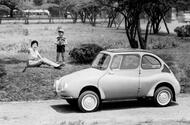
1958 Subaru 360 popularised kei class
In light of the EU’s proposals for a new small vehicle class, we look back at the birth of the Japanese kei car
The EU’s leaders recently accepted an industry proposal for a new class of small, low-cost cars as European manufacturers struggle to remain competitive while being forced into electrification.
Named E-car, this takes inspiration from Japan’s thriving kei jidosha (‘light vehicle’) class, which arose from a very different scenario in 1949.
Pre-war Japan lagged far behind Western nations in its motorisation, but it did produce vehicles – albeit predominantly motorbikes and three-wheeled trucks, of which annual production peaked at just 15,000.
The default transport for commerce remained ox-drawn carts; for individuals it had quickly become the bicycle. Japanese-built cars were expensive and few.
Under Allied occupation after losing World War II, Japan was prohibited from making cars – although it was hardly capable of doing so anyhow, its industrial base having been all but erased by years of ceaseless bombing.
Circumstances changed when combat broke out in Korea in 1948. This spurred the Allies to import greater quantities of heavy oil and iron ore to Japan, resulting in increased availability of the materials needed for vehicles.
Then, in October 1949, the Japanese Ministry of Commerce and Industry announced a Basic Policy for the Automobile Industry, ending material rationing and encouraging corporate rationalisation.
A letter by a young Autocar reader from Yokohama, Isamu Uchiyama, captured why government help was needed: “Last amongst the war-torn countries to make a comeback in car engineering seems to be Japan. As a Japanese, I regret this 10-year lag, the reasons for which are familiar: lack of inventive talent, inexperienced technique and inferior raw materials. Even if a designer conceived an ideal model, factory equipment is not up to its production. Yet Japan is a car country, for traffic conditions today are heavier than ever before.”
Enjoy full access to the complete Autocar archive at the magazineshop.com
An amendment to Japan’s vehicle regulations in 1949 then created a new category for cheap, light (‘kei’) vehicles. None were actually made to this specification, though; that happened after a 1950 amendment that distinguished between two-, three-, and four-wheeled vehicles and significantly increased the maximum vehicle size to 3m long, 1.3m wide and 2.0m high, and a 1951 amendment that upped the maximum engine size to 360cc.
The very first kei car, then, came out in 1952: the Auto Sandal, a tiny two-seater built by pre-war three-wheeler specialist Nakano with a Mitsubishi engine.
Another pioneer – a less goofy-looking one – was the 1954 Flying Feather, designed by a former Datsun engineer and produced by Suminoe.
However, an unnoticeable 200 Sandals and 48 Feathers were sold over the next couple of years.
Real impetus came in May 1955: as part of governmental efforts to rebuild the Japanese economy in a new fashion, the Ministry of Trade and Industry announced the People’s Car Development Network Plan.
This called for a car with two or four seats; the ability to carry more than 100kg of luggage; a top speed above 62mph; 85mpg economy; an engine of 350-500cc; a kerb weight of 400kg; daily production of 2000; and a production cost below ¥150,000 (about £4800 in modern money).
Understandably, most firms considered this too tall an order, especially without any government subsidies for development. But one really rose to the challenge: Subaru, newly established from elements of the old Nakajima aircraft company.
We drove its 360 kei car in 1958, saying: “It has first-class suspension, which is commendably supple, yet the considerable wheel travel has entailed no sacrifices in stability and there is practically no roll. Its little engine is extremely smooth, by no means noisy and is very spirited.” Our only criticism was the lack of a gearbox synchromesh, considering its buyers would be novice drivers.
That same year, the first true kei commercial vehicle also emerged a van based on the Suzuki Suzulite.
The Subaru proved an immediate hit, and it and Suzuki’s saloon were soon challenged by rivals from Mazda, Datsun and Mitsubishi, and consequently kei car sales ballooned from a mere 48 in 1955 and 1102 in 1958 to 77,632 in 1960.
And although they were rapidly outsold by ‘proper’ Japanese small cars, they remain an important and beloved feature of Japan to this day.