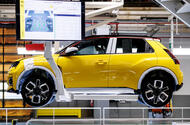
Ampere spin-off was supposed to generate huge profits but has been folded back into the Renault mothership
Ampere was spun out of Renault at the end of 2023 to take control of the company’s EV and software development – but right from the start, investors were sceptical.
“What’s the point?” asked Daniel Roeska, analyst at the bank Bernstein, following then Renault Group CEO Luca de Meo’s big pitch.
The idea was that Ampere was to be a “new model of a car company” with the speed and flat decision making of a start-up. With 11,000 Renault employees wearing an Ampere badge, the organisation was sizeable.
Now new Renault boss François Provost has sided with the sceptics and absorbed Ampere back into Renault. Development and production of EVs as well as software engineering is now part of the main group again, according a spokesperson.
So what happened? Ampere was one of de Meo’s grandest kite-flying exercises. The big plan was to carve out this separate company and attract investors, including Alliance partners Nissan and Mitsubishi.
Set in the final days of sunny EV optimism amid crazy valuations for EV start-ups, de Meo’s goal was to float Ampere as a standalone entity in the hope of sparking some investor enthusiasm that was lacking for the parent company.
Straight away analysts were asking why, if EV and software were going to juice the company’s valuation, did de Meo want to punish existing investors in Renault by stripping out the one element that might move the stubbornly low share price?
Indeed, Roeska pointed out that Ampere would actively suck out profits from the rump company, as Renault would have to pay its EV entity for emissions credits to offset all its ICE car sales.
From the start, the IPO plans didn’t go well. The planned €800 million investment from Nissan and Mitsubishi didn’t emerge and a mooted buy-in from Renault software partner Qualcomm didn’t arrive either.
By the time Ampere was ready for its IPO in the first quarter of 2024, the mood music had shifted on electric cars and start-up valuations tumbled to rock bottom. Renault cancelled plans to float Ampere and from then on its days were numbered.
De Meo’s decision to jump ship to Gucci parent company Kering and the subsequent elevation of Provost to the top job at Renault in July last year brought a shift in focus among the top team.
“[Provost] has made a lot noise about simplification, focusing on the core challenges, moving faster to resist the threat of the Chinese,” said one senior figure with knowledge of the decision process. “He’s clearly trying to remove a layer of decision-making in a really crucial part of the company.”
Far from being flat and fast, Ampere actually created complexity in the Renault organisation. Jobs were duplicated and the separate structure no longer made sense. The whole of Renault needed to be agile, not just Ampere.
The reintegration had already begun with the appointment of Philippe Brunet as chief technology officer for both Ampere and the Renault Group in September 2025.
Ampere’s role as a pure EV player was also complicated by the likely decision to incorporate a range-extending petrol engine from Horse Powertrain into the replacement Ampr Medium platform underpinning the next Renault Scenic.
This platform was a big part of Ampere’s remit, according to de Meo’s 2023 announcement, with a target to cut costs by 40% compared to the current Ampr Medium platform (formerly named CMF-EV). It’s also at the heart of Renault’s core European business going forward.
Provost deciding to fold Ampere back into the Renault organisation follows his earlier back-to-basics decision to cut the rope on Renault’s nascent mobility arm, Mobilize.
The Mobilize entity was crafted by de Meo from elements of the Renault organisation deemed to be outside the central car-making thrust of the group such as leasing, car sharing, subscription and charging, with the potential to do great things to the bottom line. The goal was that Mobilize would account for 20% of Renault Group revenue by 2030.
Now, however, its two car-sharing vehicles, the ‘Twizy Mk2’ Duo and Bento, have been axed and the Zity car-share service in Milan has been shuttered, with operations in Madrid ending next year.
The charging and energy business, including developing vehicle-to-grid solutions have been folded back into Renault, with the company describing them as a “priority”.
Provost is turning out to be pragmatic where de Meo was more willing to take a risk, but their actions also reflect changes in the wider automotive industry.
Whereas the early 2020s promoted free-wheeling optimism that car companies could broaden their manufacturing role, 2026 marks a retrenching to core abilities to provide cover from multiple threats including tariffs, political instability, Chinese competition and uncertainty over EV regulation.