With a passenger on board, the Temerario hits two tonnes – even with a £37,000 lightweight pack
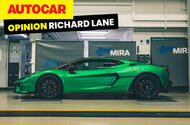
I recently put the new Lamborghini Temerario on the weighbridge at MIRA. It had the Alleggerita pack fitted, which for a trifling £37k saves you about the mass of a small Labrador.
Up popped the numbers, one for each corner. I always double-check these green digits as they go in my notebook, but this time was compelled to triple-check. At the facility that houses the weighbridge works an engineer with whom I play guess the weight for every test car. We squinted at the numbers solemnly. Both of us were frankly miles off, more on which in a moment. In the meantime, have a punt yourself.
So how much should a supercar weigh? As little as possible, but we ought to recognise that today’s mainstream manufacturers, forced into hybridisation and penned in by lots of other homologation guard rails besides, can’t easily go below 1400kg.
I’d therefore say a supercar with the contact patch and engine required to cut it performance-wise in the modern era, along with the cockpit conveniences and safety apparatus we now expect, should be no more than 1550kg-ish fuelled.
That’s a fair threshold in an era when we have all but unfettered access to carbon this, Inconel that and very advanced metallurgy.
My mind drifts to the Ferrari 458 Italia. It remains the Platonic ideal of the modern supercar in so many ways, doesn’t it? When we road tested one in 2010, it hit 100mph in exactly seven seconds and stopped from 70mph in 41.8m on its Michelin Pilot Sport tyres. Red-hot performance. It did it with 562bhp and in the region of 360bhp per tonne, which feels like the sweet spot for a usable supercar with lots of airbags, air conditioning and a passably good hi-fi system.
Interestingly, the high-brow driver’s car du jour, Porsche’s stunning 911 S/T, has an almost identical power-to-weight ratio.
Current supercars are another matter: 460bhp or so per tonne is now table stakes. Those mad numbers mask a problem, though, which is that the cars are getting worryingly tubby, even for makers for which lightness is key.
The McLaren Artura we tested in 2022 came in at 1552kg, despite its carbonfibre tub and fairly spartan interior. The Ferrari 296 GTB was 1648kg. (This tallies, given that both use a twin-turbo V6 and a solitary electric motor mated to the gearbox, and a carbon tub typically saves you around 100kg.) These are substantial numbers for machines that still have modest footprints and are purely RWD.
Still, as kerb weights go, those figures remain faintly palatable. But the Temerario? It set a new class record of 1905kg, even with its £37k diet pack. We will explain how astonishingly well the ‘junior’ Lambo hides its mass in the road test proper, but in isolation this figure has set alarms ringing, just as the advent of the 2.4-tonne BMW M5 did.
The Revuelto weighed even more, at 1960kg, but it has a 6.5-litre V12 and is so alien that its corpulence doesn’t initially register. The Temerario is something that could plausibly be cross-shopped with a 911 GT3, yet with a passenger, the thing weighs fully two tonnes.
In its defence, the Temerario carries all the hardware you can throw at a supercar in 2025: battery pack down the central spine; electric motor between turbocharged V8 and dual-clutch gearbox; another two motors on the front axle. In the old Huracán, a little Haldex clutch pack and some spindly half-shafts sufficed for the delivery of 4WD.
It can’t be easy to keep the chub at bay if you’ve essentially been forced down the road of hybridisation and the 4WD is part of your brand identity. We should make allowances for that.
More cynically, you could say that because Lamborghini knows its customers care about looks, noise and raw performance, it hasn’t tried very hard to keep the kilos at bay. Why would you, when 907bhp will still give you an outrageous 476bhp per tonne?
Beyond 600bhp, I’d take 200kg less over 200bhp more every time. But sadly it doesn’t work like that and, in supercar land, being less powerful than your predecessor is sales suicide.
I wonder if the current crop of supercars, stellar as they are to drive, represents a dubious high-water mark for kerb weights. I do hope so. After all, the hardware is in place now. Turbos, batteries, motors, driveshafts. With the caveat that batteries will get bigger as electricity becomes a more equal partner in the hybrid blend (as seen in Formula 1), there’s no reason for these cars to get heavier.
I don’t honestly believe we will get to the point where two tonnes is considered normal for mainstream supercars, but the possibility worries me.