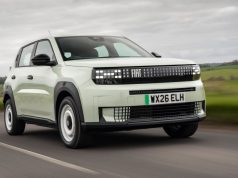

Mk1 Renault Duster “started the compact SUV segment” in India. Now it’s back – and more bespoke than ever
Renault has revealed the second generation of its hugely popular Duster crossover for India, as the next step in its £2.2 billion plan to dramatically grow market share outside of Europe.
Similar-looking but unrelated to the Dacia Duster sold in Europe, the chunky new addition to Renault’s line-up is the follow-up to a car that Renault claims “started the compact SUV segment” in India.
It has the potential to play a transformative role in Renault’s bid to swell sales worldwide, with the Indian car market (the world’s third largest) now accounting for 4.3m units per year – and growing by between 5% and 10% annually.
Given that the Mk1 Renault Duster sold 40,000 units per year “at a time when the SUV was only about 10% of the market”, explained product boss Bruno Vanel, this new generation has especially “huge potential”, with SUVs now accounting for more than half of all cars sold in India.
Key rivals include the Indian-built, five-door Maruti Suzuki Jimny, the Hyundai Creta and the recently renewed Tata Sierra.
The legacy of the Mk1 Renault Duster is so strong in India, said Vanel, that it’s comparable to “talking about the Jeep” in the US – which is the main reason the new car has ‘Duster’ spelled out across its front end, rather than ‘Renault’.
Renault CEO Fabrice Cambolive told reporters at the car’s unveiling: “We have the name on the front of the car as a record of the fact that Duster for Renault is a global car with a legacy.
“There are 1.4 billion inhabitants in India, which means the cost of awareness and familiarity when you launch a car is huge, and the fact we’ve used Duster not as a brand but as a reference on the face of the car is an enabler to be much more efficient in representing the market.”
While the Mk1 Renault Duster was largely based on the Mk1 Dacia Duster, however, this latest version uses a different platform to the European car, has its own bespoke design inside and out and uses a different selection of powertrains – as part of Renault’s drive to cater more explicitly to local demands in the various global markets in which it operates.
It’s based on an adapted version of the CMF-B platform that underpins the Dacia Duster, with slightly different dimensions and a chassis that has been engineered to suit demanding local driving situations by Renault’s newly founded Indian engineering centre.
Renault called particular attention to its new Duster’s approach and departure angles of 25.7deg and 29.2deg, which enhance its potential to “venture well beyond the beaten track”.
Designed in India, it bears a strong resemblance to the Dacia Duster but with a number of defining cues that bring it into line with Renault’s global design language – including its trapezoidal grille and familiar LED light signatures.
Inside, it’s completely unrelated to the Dacia Duster, with a dashboard that’s more in keeping with Renault’s latest European-market SUVs. There’s a 7in or 10.25in driver display and a 10.1in portrait touchscreen, both running the latest Google-based system with Gemini AI functionality, and a raised centre console that Renault says is “inspired by high-end models” like the Austral and Rafale.
Renault’s local design and engineering insights have also shaped the kit list, with the Duster coming as standard with electrically adjustable and ventilated seats, a panoramic sunroof, an electric bootlid and – especially important – a smartphone app to control various functions remotely.
Vanel said it was particularly important “to be able to switch on the ventilation and the air conditioning in a country which has a lot of hot days in the year”.
The new Duster will be offered with either the mild-hybrid TCe 100 petrol powertrain, paired with a six-speed manual gearbox, or the more powerful TCe 160 full-hybrid system that’s available here in the Symbioz, with the option of a dual-clutch automatic ‘box.
The Duster’s unveiling comes shortly after Renault unwrapped the much larger Filante, a premium-oriented SUV based on Geely underpinnings and built in South Korea for the local and Middle Eastern markets.
The Duster will be built at Renault’s factory in Chennai, which it used to share with Nissan but now owns outright, alongside the Triber mini-MPV and the rugged, raised Kiger hatchback.
Indian sales will begin in spring, before exports to South Africa and the Middle East begin at a later date.