
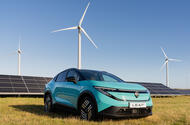
AESC plant builds batteries for the new Nissan Leaf, which is assembled next door
Vast cell-making plant next to Nissan in Sunderland has just been completed with annual capacity of 15.8GWh
“In all honesty, I don’t care about the production schedule.” In an industry in which just-in-time parts delivery has unlocked huge productivity, this statement from an executive at Nissan battery supplier AESC in Sunderland is eye-opening.
Chinese-owned, Japanese-headquartered AESC has just completed a vast new cell-making plant slap-bang next to Nissan’s plant on Wearside at a cost of £1 billion and has begun supplying batteries for the new Nissan Leaf crossover.
No one at the plant wants to hold up production of this key new electric car, but quality manager Connor Huntingdon absolutely will if he isn’t happy with the purity of the materials coming into the facility.
“If we have question marks, that material will not go to the production department,” he said. “We will block it. We will stop it. And we have the ultimate authority to do that.”
In a world of fast-shifting battery hierarchies, AESC (formerly Automotive Energy Supply Corporation) is an old hand. The company has been building Leaf batteries in Sunderland since 2012, back when Nissan owned a majority stake.
The Japanese giant sold its share to China’s Envision Group back in 2018, but the supplier relationship between the two companies remains rock-solid.
When Nissan announced in 2021 that Sunderland was to significantly ramp up its EV production with a new Leaf and other electric models, AESC similarly revealed plans for a huge, 15.8GWh plant in place of the old 1.8GWh facility.
Now the facility is ready, and AESC threw open the doors to journalists in December to coincide with a ceremony to mark the start of Leaf production.
Whereas the old plant was a relatively modest two-story building beside the Nissan Sunderland site, the new one is 10 stories tall and looms large across the road.
“This represents a significant scale up from a volume for us as a business,” said Jim Marley, head of AESC’s European operations.
The plant manufacturers electrodes (anode and cathode) for the first time and claims to have the biggest ‘clean room’ in Europe, where this initial stage takes place.
Successful battery manufacturing is measured in many ways, but quality is key. AESC’s track record is good, but there are plenty of cautionary tales in this business of car makers having to recall tens of thousands of EVs and PHEVs because of faulty batteries. Large-scale recalls from Hyundai, Porsche, Ford and General Motors involving packs from South Korean supplier LG Chem are perhaps the most visible.
At Sunderland, Huntingdon forces every delivery tanker and lorry to wait while his quality assurance team runs tests on their load.
The lab is relatively small, about the size of a large chemistry classroom, but the machines are far more sophisticated.
A battery is made up of the graphite anode, the cathode (here a mix of nickel, manganese and cobalt, or NMC) divided by a porous layer and soaked in a liquid electrolyte.
Any contaminates, even at minute, almost homeopathic levels, can destroy a cell over time. “Moisture or anything metallic is the enemy,” says Huntingdon. “Moisture causes chemical breakdown and gassing, metal particles create short circuits.”
After anywhere between an hour and two and a half, the materials are cleared or rejected for production.
After the physicality of a car factory with its huge robots, clanking presses and labour-intensive assembly lines, a battery plant is a very different beast. Much is automated behind glassed-in lines both to protect the cells from contaminants and keep workers away from gases and laser welders.
Marley reckons the plant will employ upwards of 1000 people when production moves from one line to four “in a matter of months”. That’s compared with more than 6000 at the Nissan Sunderland plant next door.
The volatility of the chemicals involved means that a cell spends far longer in the plant than a car would next door, with eight or nine days needed. The initial mixture creates gases, mainly hydrogen, that has to be bled off.
Much of the time the cells are sat waiting, stacked up, to become stable enough before they can be packed into modules. Much of the 10-storey height is taken up with racking.
AESC is coy about where it sources raw materials for the cell production, but it’s clear that China is a major supplier. Aside from the company being Chinese-owned, the country has an iron grip on much of the refined materials that make up a finished battery.
Even less specialist items have a Chinese connection. For example, the battery boxes for the Leaf are made locally by China’s Minth Group.
AESC has also been coy about who else it would supply from its Sunderland plant. Marley wouldn’t confirm rumours that Sunderland would supply packs to JLR for the new Range Rover Electric and Jaguar GT, but AESC has been open about wanting to attract new customers.
A plant size of 15.8GWh has enough capacity to supply 210,000 Leafs with the largest 75kWh battery pack each year. The upcoming Nissan Juke EV will use the same packs, but that still won’t cover the plant’s total output.
AESC is also supplying knowhow to the Agratas battery plant that’s currently being constructed in Bridgewater, Somerset (the shell can now be seen from the M5 motorway), the Financial Times reported in 2023.
For now, however, the great British battery hope is pinned on Sunderland, with the government in particular crossing its fingers, having guaranteed more than half a billion of the financing.