
KEY POINTS
After 25 years, Cisco’s share price has finally recovered from its post-dot-com crash lows.
The long journey required a rebrand of its services, including a focus on AI services and subscriptions.
The company has now rewarded shareholders with earnings beats in 32 out of the past 33 quarters dating back to 2017.
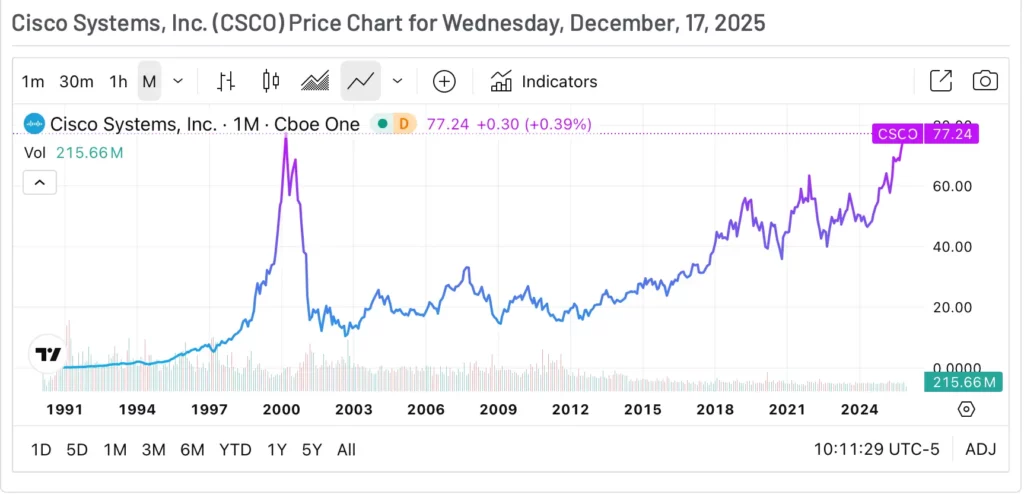
It has been a long time coming, but after 25 long years, shares of networking hardware, software and telecommunications equipment provider Cisco Systems NASDAQ: CSCO have finally rebounded from the lows it experienced in the wake of the dot-com crash in March 2000. As the graph below shows.
Bottoming out at $10.32 on Oct. 11, 2002, the stock has gained more than 658% since, while stringing together an impressive run that includes 32 earnings beats in its last 33 quarters dating back to Q3 2017.
In March 2000, at the height of the dot-com boom, Cisco Systems became the most valuable company in the world. I remember the day well as i was often on the Cisco campus working as a partner in the SoftSwitch / VoIP space. Its share price soared on expectations that the internet would transform business, communications, and society itself. In many ways, that belief was correct — but for Cisco shareholders, the journey that followed was far more painful than anyone anticipated.
It has taken roughly 25 years for Cisco’s share price to meaningfully recover from its dot-com era peak. This long road back offers an important lesson for investors in valuation, expectations, and long-term returns.
Cisco at the Peak of the Dot-Com Bubble
At its peak in 2000, Cisco was seen as a “must-own” stock. The company dominated networking hardware, selling routers and switches that formed the backbone of the rapidly expanding internet.
However, the valuation told a different story:
Cisco traded at extraordinarily high earnings multiples
Growth expectations assumed years of uninterrupted expansion
Any slowdown, however minor, would trigger a reassessment
When the dot-com bubble burst, reality set in quickly.
The Crash — and the Long Aftermath
Cisco’s share price collapsed by more than 80% between 2000 and 2002. Unlike many dot-com companies, Cisco did not fail — it remained profitable, cash-generative, and operationally strong. But strong fundamentals alone were not enough to rescue investors who bought at peak valuations.
For years afterward:
Revenue growth slowed as markets matured
Competition increased
Investor enthusiasm for legacy tech waned
The stock moved sideways for long stretches
Even as Cisco continued to generate billions in cash and remained a global technology leader, its share price struggled to regain lost ground.
Why Did Recovery Take So Long?
Cisco’s story highlights a key investing truth: a great company can still be a poor investment if bought at the wrong price.
Several factors contributed to the prolonged recovery:
1. Valuation Reset
The dot-com era assigned Cisco a valuation that assumed near-perfect execution indefinitely. Once those expectations were removed, the stock had to “grow into” a much more realistic price.
2. Market Maturity
Cisco’s core markets matured. Growth became incremental rather than explosive, which limited upside for valuation expansion.
3. Opportunity Cost
While Cisco moved sideways, other technology companies — particularly in software, cloud computing, and later mobile — delivered stronger returns, drawing investor capital elsewhere.
4. Time, Not Failure
Importantly, Cisco did not spend 25 years “fixing” its business. Instead, it spent 25 years allowing earnings, dividends, and buybacks to slowly justify a return to previous price levels.
Lessons for Today’s Investors
Cisco’s experience remains highly relevant, especially in markets where certain stocks or sectors attract intense enthusiasm.
Key takeaways include:
Valuation matters, even for world-class companies
High growth expectations leave little margin for error
Long-term recovery can take decades, not years
Dividends and cash flow help, but may not offset an inflated entry price
For investors focused on long-term capital growth, Cisco serves as a reminder that avoiding extreme overvaluation can be just as important as identifying great businesses.
A Quiet Comeback — With Perspective
Today, Cisco is a very different investment proposition. It is a mature, cash-rich company that returns capital to shareholders through dividends and buybacks. Its business remains essential to global networks, even if it no longer captures headlines.
The fact that it took around 25 years to recover from its year-2000 peak is not an indictment of Cisco as a company — it is a cautionary tale about markets, psychology, and price.
For long-term investors, Cisco’s journey reinforces a timeless principle:
The price you pay matters just as much as the company you buy.